5 Questions for Kei J. Constantinov
Kei J. Constantinov is a Midwestern-based, magic realist painter, printmaker, and novelist known for her neo-medieval, anachronistic aesthetic. She holds a Master of Fine Arts from the University of Massachusetts (Amherst) and is a Master Printer who spent seven years mentoring and editioning at the historic Bob Blackburn's Printmaking Workshop in Manhattan.
Operating out of her Studio Krakow in Michigan City, Indiana (near the Greater Chicago area), Constantinov's art and lifestyle blend historical storytelling, specialized craftsmanship, and traditional techniques.
Key highlights of her work and practice include:
Neo-Medieval & Magic Realism: Her oil and egg tempera paintings conjure an imagined European dreamtime. Inspired by masters like Albrecht Dürer, Rembrandt, and Holbein, she frequently features courtesans, vanishing landscapes, and literary figures from the medieval era.
Faux Relic Frames: Rejecting modern frames, she independently creates elaborate, bas-relief, gilded "Faux Relic" and triptych frames that serve as intricate continuations of her paintings' narratives.
Literary Work: Constantinov is also a writer and novelist, having authored "Mechtild's Medieval Adventures, an Adult Fairy Tale", which often informs the subjects in her artwork.
How has your style changed over time?
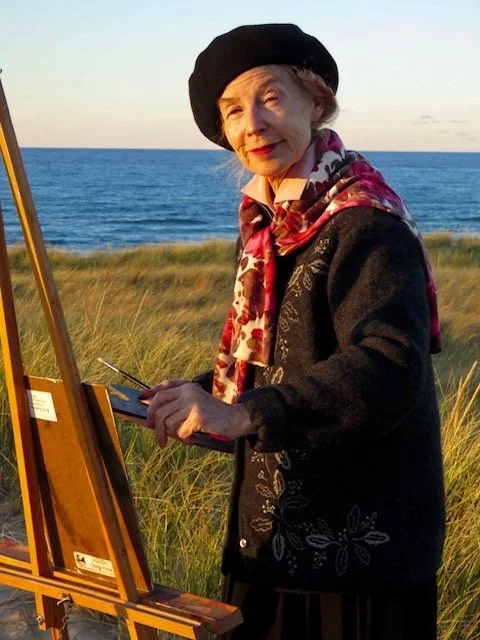
A medieval thread runs through my career, originating from teen reading, inspiring the publication of my novella Mechtild's Medieval Adventures, and An Adult Fairy Tale decades later. From the wellspring of my writing arose another decade of “Faux Relics”, or heavily antiqued oils embedded in seemingly ebonized, gilded and heavily carved frames. Forgers varnish carried the conceit farther, as though they’d been recovered from a feudal manor house.
Since joining the Palette & Chisel, an old art academy in Chicago, my activity revolves more around 5”x7” egg tempera master studies, anatomy and live figure drawing. Portraiture will be important going forward.
How do you select the subjects or models you paint?
There is an “idee fixe” from which my imagery arises, often from an encounter with a striking or notable character real or literary. My preferred surface, if sufficiently intrigued by the subject, is a time honored formula on Ampersand’s Gessobord, executed in many transparent layers of oil or egg tempera.
How has your upbringing or background influenced your current work or series?
Following an MFA (1983) I was awarded a Revson Grant by the Art Students League in NYC, for an artist book evoked by medieval illuminated manuscripts, using stone lithography and handset type. This prize came as full support of rent, food and a monthly stipend for one year. The freedom this afforded me to entertain, publish and attend cultural events would be unimaginable in today’s climate. The award, along with teaching lithography in a venerable printmaking atelier in Chelsea, NYC, where I worked for seven years, introduced me to people of import, and was invaluable.
Which colors must you have in your palette before starting a painting?
Because of my training as a Master Lithographer using transparent ink overlays to achieve a full color range, I find color mixing delightful. - not mysterious. Regarding a palette I find most useful, I look to green earth or chromium green (or a verdaccio green mixed from ivory back and yellow ochre), with lead white, brown umbers, raw and burnt sienna, plus transparent red oxide. “Guest colors” may be added at conclusion, to push or subdue chroma as needed for emotional effect.
Which was your breakthrough artwork and tell us what happened after?
The Midwest Museum of American Art awarded a faux relic-framed “Humble Things” (2021) their Best of Category (mixed media), along with an invitation to present my 30-slide Power Point presentation before a paying audience of fifty. Therein I documented a biography, the process of creating Faux Relic Frames, gilded oil painting secrets and such. This in many ways can be traced back to the common thread begun with the Art Students League grant of 1985.