5 Questions For Vicki Sullivan

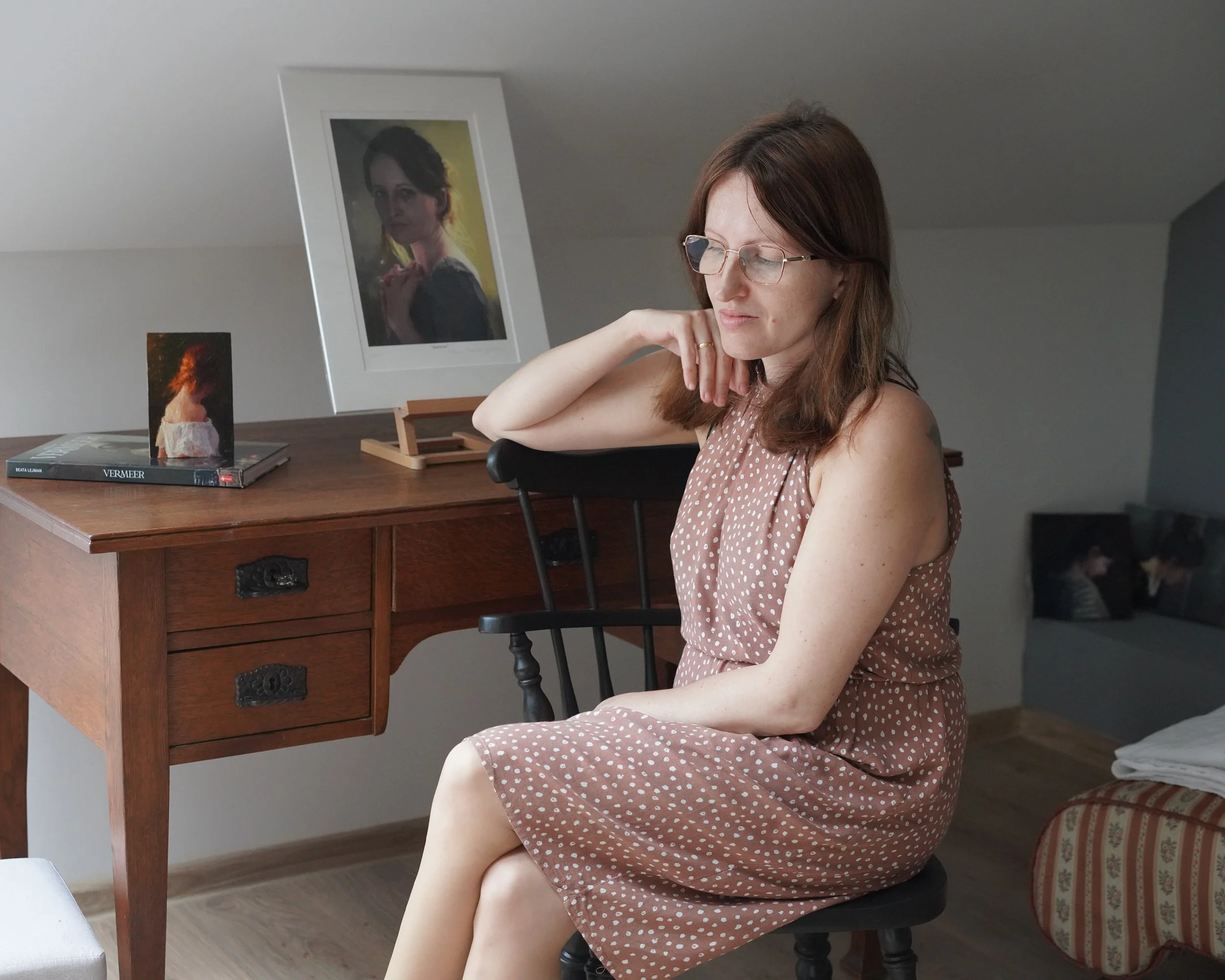
Which colors must you have in your palette before starting a painting?

I usually begin my paintings by drawing them out in raw umber as an underpainting. The other colors on my palette are a direct response to my painting subject.

What is the best advice you have received in your career?

Not everyone will like your work so find where they do like it and find opportunities to get your work in front of them.

Which was your breakthrough artwork and tell us what happened after?

My breakthrough work was a portrait of my niece, it was my first successful realistic portrait and I entered it into an art prize and it won the two big prizes in the show.

How do you select the subjects or models you paint?

I often choose models who I find interesting to paint and also I like to paint people standing up for human rights.

How has social media impacted your daily routine or work ethics?

Like most artists these days social media has become a part of the process. It has allowed people from around the world to see and also collect my work all over the world

Vicki Sullivan’s paintings draw from a deep appreciation of beauty. Sullivan is a contemporary classical realist combining the aesthetics of the old masters with a modern edge. Finding her inspiration in people and nature Sullivan chooses oil paint as her medium. Her love of vibrant and opulent colour often requires employing many layers of paint to make her colour lavish and glowing as if from the inside. Chiaroscuro brings drama to her work, which often uses symbolism while exploring the universality of myth and emotional memories. Her work aims to stir the imagination and create an emotional connection with her viewer.

5 Questions for Onur Sarial

How do you relay emotion in your work?

I relay emotion not through exaggerated expressions, but through the physical tension of the anatomy and the dramatic collision of light and shadow. I use a strict Tenebrism approach. By enveloping my subjects in absolute, pitch-black darkness, I isolate them from the chaotic world. The emotion lies in the silent, sculptural presence of the form emerging from that deep void, forcing the viewer to confront the raw human condition.

How has social media impacted your daily routine or work ethics?

My daily routine is built on severe discipline and isolation, much like an athlete's regimen. While social media is an excellent tool for sharing the final result with a global audience, it has zero impact on my work ethic. True creation requires absolute silence. When I am in my studio, working behind an acetate shield for hundreds of hours, listening to classical music and applying charcoal dust micron by micron, the noise of the digital world ceases to exist.

How do you select the subjects or models in your drawings?

I never seek flawless or idealized beauty. I am captivated by the weight of time on the human body. I look for life that has been authentically lived—deep wrinkles, the structural tension of veins in aging hands, the rough texture of skin. My subjects must carry a silent history. I choose models whose physical reality allows me to carve out the truth using only light and shadow.

Which colors must you have in your palette before starting to work?

I do not use colors. My palette is completely stripped of them; it consists entirely of the absolute black of charcoal and the pure white of the paper. I am not chasing hues; I am an architect of form and light. By removing the distraction of color, I leave only the naked truth of the anatomy. My entire focus is on building optical realism through the darkest shadows and the sharpest highlights.

Which was your breakthrough artwork and tell us what happened after?

My true breakthrough was the moment my relentless dedication to figurative realism was recognized on the global stage, particularly with my artwork "Mirada". Having it selected for exhibition at the prestigious MEAM Museum in Barcelona, and subsequently being featured in the ModPortrait competition and the Leonardo 2026 guide, was a monumental shift. It validated my years of solitary, uncompromising work and proved that the strict, classical discipline of charcoal realism still commands immense respect in the contemporary art world.


Onur Sarıal (b. 1985) is an internationally recognized contemporary figurative artist based in Istanbul, Turkey, who specializes in charcoal realism and the dramatic art styles of Tenebrism and chiaroscuro. His highly sought-after drawings—crafted on materials like professional Pastelmat—focus heavily on human psychology, vulnerability, and the interplay between light and absolute darkness.

Visit listing on Artsy to learn more.

5 Questions for Kei J. Constantinov

Kei J. Constantinov is a Midwestern-based, magic realist painter, printmaker, and novelist known for her neo-medieval, anachronistic aesthetic. She holds a Master of Fine Arts from the University of Massachusetts (Amherst) and is a Master Printer who spent seven years mentoring and editioning at the historic Bob Blackburn's Printmaking Workshop in Manhattan.

Operating out of her Studio Krakow in Michigan City, Indiana (near the Greater Chicago area), Constantinov's art and lifestyle blend historical storytelling, specialized craftsmanship, and traditional techniques.

Key highlights of her work and practice include:

  • Neo-Medieval & Magic Realism: Her oil and egg tempera paintings conjure an imagined European dreamtime. Inspired by masters like Albrecht Dürer, Rembrandt, and Holbein, she frequently features courtesans, vanishing landscapes, and literary figures from the medieval era.

  • Faux Relic Frames: Rejecting modern frames, she independently creates elaborate, bas-relief, gilded "Faux Relic" and triptych frames that serve as intricate continuations of her paintings' narratives.

  • Literary Work: Constantinov is also a writer and novelist, having authored "Mechtild's Medieval Adventures, an Adult Fairy Tale", which often informs the subjects in her artwork.

How has your style changed over time?  
A medieval thread runs through my career, originating from teen reading, inspiring the publication of my novella Mechtild's Medieval Adventures, and An Adult Fairy Tale decades later.  From the wellspring of my writing arose another decade of “Faux Relics”, or heavily antiqued oils embedded in seemingly ebonized, gilded and heavily carved frames.  Forgers varnish carried the conceit farther, as though they’d been recovered from a feudal manor house.  

Since joining the Palette & Chisel, an old art academy in Chicago, my activity revolves more around 5”x7” egg tempera master studies, anatomy and live figure drawing. Portraiture will be important going forward.

How do you select the subjects or models you paint? 
There is an “idee fixe” from which my imagery arises, often from an encounter with a striking or notable character real or literary.  My preferred surface, if sufficiently intrigued by the subject, is a time honored formula on Ampersand’s Gessobord, executed in many transparent layers of oil or egg tempera.

How has your upbringing or background influenced your current work or series?
Following an MFA (1983) I was awarded a Revson Grant by the Art Students League in NYC, for an artist book evoked by medieval illuminated manuscripts, using stone lithography and handset type.  This prize came as full support of rent, food and a monthly stipend for one year.  The freedom this afforded me to entertain, publish and attend cultural events would be unimaginable in today’s climate.  The award, along with teaching lithography in a venerable printmaking atelier in Chelsea, NYC, where I worked for seven years, introduced me to people of import, and was invaluable.

Which colors must you have in your palette before starting a painting? 
Because of my training as a Master Lithographer using transparent ink overlays to achieve a full color range, I find color mixing delightful. - not mysterious.  Regarding a palette I find most useful, I look to green earth or chromium green (or a verdaccio green mixed from ivory back and yellow ochre), with lead white, brown umbers, raw and burnt sienna, plus transparent red oxide.  “Guest colors” may be added at conclusion, to push or subdue chroma as needed for emotional effect.

Which was your breakthrough artwork and tell us what happened after? 
The Midwest Museum of American Art awarded a faux relic-framed “Humble Things” (2021) their Best of Category (mixed media), along with an invitation to present my 30-slide Power Point presentation before a paying audience of fifty.  Therein I documented a biography, the process of creating Faux Relic Frames, gilded oil painting secrets and such.   This in many ways can be traced back to the common thread begun with the Art Students League grant of 1985.

The Oneiric Visions of Erica Calardo

In the contemporary art landscape, few artists manage to bridge the gap between the rigorous precision of mathematical logic and the ethereal, often haunting beauty of figurative painting. Erica Calardo, an Italian artist based in the historic heart of Bologna, achieves this with a mastery that feels both timeless and profoundly modern. Her recent viewing room at 33 Contemporary on Artsy offers a captivating window into her "oneiric" world—a realm where the solitude of lost souls meets the grandeur of the Italian Renaissance.

From Logic to Linen: The Artist’s Evolution

Erica Calardo’s path to the easel is as unconventional as her subjects. Born in Genoa in 1980, she spent a decade as an academic researcher, holding a PhD in mathematical logic. This background in the abstract and the structured informs the underlying clarity and symbolic depth of her work. Today, her atelier in Bologna—surrounded by ancient stones, warm colors, and the mysteries of old masters—serves as the crucible for her visions.

Calardo is largely self-taught, having honed her skills through "old dusty books" before studying under the renowned Italian master Roberto Ferri. Her technique is deeply rooted in the Italian tradition, drawing inspiration from Mannerist and Renaissance icons such as Leonardo da Vinci, Bronzino, and Lavinia Fontana.

The Aesthetic of the "Oneiric" Feminine

Calardo’s paintings are characterized by what she describes as "oneiric feminine figures." These are not merely portraits; they are windows into a timeless past, telling tales of forgotten dreams and the "solitude of lost souls." Her work explores the delicate intersection of:

  • Beauty and the Grotesque: Finding grace in the unsettling and the eerie.

  • Magic and Mystery: Infusing figurative realism with a sense of the supernatural.

  • Solitude: Capturing the quiet, introspective moments of her subjects.

Her palette often reflects the "warm colors" of Bologna, yet her subjects frequently inhabit dark, atmospheric spaces that evoke the "memento mori" of the Victorian age and the haunting atmosphere of ghost stories.

Erica Calardo

Magdalena, 2021

Oil on linen

40 × 27 1/2 in | 101.6 × 69.9 cm

A Dialogue with the Past

One of the most striking aspects of Calardo’s work is her ability to engage in a dialogue with art history. Her portraits of Leonora Carrington, Remedios Varo, and Frida Kahlo are not just likenesses; they are acts of artistic lineage. By painting these women, Calardo situates herself within a tradition of female surrealists and figurative painters who used the human form to explore the depths of the psyche.

Her work Suspirium (2020) and Magdalena (2021) further demonstrate her ability to take classical themes—the breath of life, the penitent figure—and imbue them with a contemporary, slightly punk-rock edge. This fusion of the baroque and the rebellious is what makes her work so distinctive in the current figurative scene.

Conclusion: Living in a Dream

For Erica Calardo, being an artist is "like living every day in a dream." This sentiment is palpable in every brushstroke of the works featured in the 33 Contemporary viewing room. Whether she is exploring the "solitude of lost souls" or paying homage to the giants of art history, Calardo invites the viewer to step out of time and into a world of magic, logic, and profound beauty.

To explore these works further and experience the oneiric visions of Erica Calardo, visit the 33 Contemporary viewing room on Artsy.

"When I’m painting I feel connected to my deepest nature. There is only me, my easel, my visions. The colours, the soft brushes, the scent of walnut oil." — Erica Calardo

Erica Calardo

Moments of Gesture | Nanette Fluhr

Notes on Nanette Fluhr by John Hughes

Nanette Fluhr

Autumn, 2022

Oil on masonite board

21 4/5 × 18 in | 55.4 × 45.7 cm

Frame included

In Autumn, Nanette Fluhr stages a lush threshold. The medium—oil on masonite—supports a saturation of color that feels less applied than emanated. The tones gather in a kind of dusk-light, warm and interior, as if illumination were arising from within the surface rather than falling upon it.

The drapery over the figure’s head offers a quiet allegory. Its autumnal leaves, in deep reds, ochres, and golds, unfold against a ground of black. Yet this black does not register as darkness in any oppressive sense. It does not foreclose the image. Instead, it deepens it. The leaves do not fall into shadow; they seem to be carried by it, held within it.

The woman’s posture—head inclined, eyes closed—withdraws from outward address. She is not presented for the viewer, but turned inward, as if receiving something. The gesture is contemplative, performative as such. While the figure is beautiful, the painting resists eroticization. Beauty here is not offered but absorbed. The viewer joins sympathetically in a gesture of spiritual inwardness.

Light as always is of the essence. The background glows softly, without a defined source, allowing the figure to emerge gradually rather than sharply. This diffusion creates a gentle oscillation of attention: the eye settles on the figure, drifts outward, then returns. The space feels less like a setting than a field of presence.

What the painting ultimately proposes is a reversal. Autumn, conventionally aligned with decline or loss, becomes here a moment of arrival. Not an approach to desolation, but an entry into fullness. The season does not empty; it gathers. The figure appears not at the edge of disappearance, but within a completed state—an immanence that is neither anticipatory nor retrospective. This is gesture in the moment, suspended as the moment's endurance.

Nanette Fluhr

Ascending, 2023

Oil on canvas

52 × 33 in | 132.1 × 83.8 cm

In Ascending, Nanette Fluhr presents a woman suspended in water, reaching upward in a state of quiet composure. The signs of submersion are delicately rendered: the drift of her clothing, the particulate shimmer of light, small bubbles gathering near her feet, the green-blue atmosphere, the steady presence of water lilies. Near the top, the surface flickers—light fractures into a trembling plane of reflection. Her hair billows gently. She is dressed in white, but the garment is unbinding rather than restrictive. The figure is not sexualized; the gaze is not directed that way. Instead, the painting situates us within a field of experience.

The realism is persuasive. The painterly handling of fabric, light, and suspension activates bodily memory—you feel the slowed physics of water, its resistance, its hush. The cues are subtle but cumulative. The viewer is drawn into an environment that is immersive without being overstated, tender without becoming indulgent.

Yet the painting never relinquishes its identity as paint. Particularly at the upper threshold, the surface breaks into more gestural, abstract strokes. The illusion thins. What reads as the surface of the water is also the surface of the canvas asserting itself. The eye shifts—from depiction into material. Paint incarnates into form, yet remains irreducibly paint.

This produces a structural divide within the image. Below: suspension, interiority, a dreamlike calm—almost pre-verbal, even womb-like. Above: flicker, disturbance, a threshold—of emergence, or perhaps of perception itself.

Her upward reach can be read as ascension, but also as contact with a limit. She reaches not only toward light, but toward the point where representation begins to fail—where the image discloses its making. This limit is staged within the painting. It implies a beyond, unbounded, luminous, yet the painting itself is bounded, held within its frame. The work thus enacts a recursion: a limit that contains its own beyond. In this sense, it becomes a metaphor for freedom within materiality.

The body is not eroticized. This absence is not neutral; it reorients the figure. She is not an object of vision but a subject of experience. Desire is not eliminated but transformed: it reappears as the desire to float, to rise, to release. The loose white garment reinforces this condition. What we witness is not a body posed, but a being passing through a state. The calm is not passivity so much as consent—an openness to transformation. Consent to something freeing not subduing.

The painting operates across three interwoven registers: narrative image (a woman ascending through water), embodied sensation (buoyancy, quiet, suspension), and material awareness (paint as paint, surface as surface). These layers do not resolve into unity but remain in productive tension. That tension resists sentimentality. It reminds us that the image is constructed, mediated, made.

The ascension, then, is not only hers. It belongs equally to the painting itself: a movement between illusion and its own facture, its facticity—those moments where the surface curls back into gesture, where paint declares its presence within the very scene it sustains.


Nanette Fluhr is an internationally recognized portrait artist whose work bridges classical technique with contemporary realism. Her work has been exhibited internationally, including at the European Museum of Modern Art in Barcelona and in a six-museum tour across China. Her portraits hang in courthouses and institutions nationwide, and her painting has been sold at Sotheby's.

After graduating from Rutgers University, she earned her BFA with honors from the School of Visual Arts, where she trained under John Frederick Murray, and later at his atelier. She served as a registered copyist at the Metropolitan Museum of Art, creating master copies of works by Rembrandt, Rubens, Van Dyck, Velázquez, Lawrence, and Vigée Le Brun.

She is the recipient of the Distinguished Achievement Award for Portraiture from American Women Artists and the HerStory Award from Manhattan Arts International. Her work is permanently archived in the Lunar Codex aboard NASA-partnered missions to the moon, making her among the first women artists to have work preserved beyond Earth.

More Notes on Moments of Gesture

Notes on Moments of Gesture
by John Hughes

Nadia Ferrante

Finally I love myself, 2026

White pastel, green pastel, charcoal on cotton paper tonalized with cadmium red

17 × 30 in | 43.2 × 76.2 cm

The work of many serious painters today—those we might loosely call representational or figurative—is aligned by their common bobbing in the same moment of the day. Alive at the same time, they inevitably survey the same interconnected cultural scenery, the same mortal and existential anxieties, and they seek similar solaces through the unique craft that is making art.

The poet Wallace Stevens once said of poetry that “it must give pleasure,” and that is one criterion here as well. Yes—simple, hedonistic pleasure: the aesthetic appreciation of something too often dismissed or mistrusted, what we call Beauty. We see this first at the most immediate level—in the colors and forms present in these works. The quality of the work one observes when looking up the artists’ names is, in one sense, overwhelming, and in another sense not.

As I confided to Didi after a first perusal: “My gosh, these are serious workers.” The obsession, the diligence, the pursuit of the art—the craft both technical and emotive—is evident everywhere. One can tangibly see how figurative realism has absorbed the lessons of photography, cinema, existential thought, psychology, and hyperrealism. All of these cultural forces are sublimated into the elemental gesture of the brushstroke as it walks the line between intention and something more Delphic—something given.

When I observe one of these paintings—say, a portrait of a face, or a study of the way light passes through a glass marble—it can feel as if the whole of contemporary consciousness is faintly implied within it. These artworks carry an awareness of the observer that is particular to our time. They have absorbed the lessons of abstraction. They are not traditional in any simple sense, yet they clearly derive from very traditional lineages. One can sound very high-minded, even philosophical, writing about these paintings. But one could also say more bluntly: in their various genres and modes, they bring pleasure.

They have no problem being as beautiful or compelling as a page from Vogue or a magazine cover. Yet they move beyond that surface appeal precisely because the abstract mechanics of paint—pigment itself, whether oil, pastel, chalk, crayon, or pen—can at any moment pierce through the illusion of representation and assert itself.

If we look at paintings such as those by Nadia Ferrante, the imagery is clearly inflected by the surrounding culture. The poses feel cinematic, almost photographic. Yet more fundamentally they are crafted out of pigment, manually, by hand and eye. In that sense the painting becomes a reclamation by the organic of the technological. Likewise, in the expressions of the faces, we can faintly detect the traces of personality—each “who they are.” Each time that implied personality leaps forth as unmistakably contemporary, belonging to the present moment.

Even the lines of a face carry the history of countless micro-expressions, sensitive reactions formed within the very situation we ourselves inhabit: the shared condition of being alive together.

Patricia Schappler

Daughters and their Stories, 2026

Oil on board

9 3/4 × 8 in | 24.8 × 20.3 cm

A similar phenomenon appears in paintings such as those by Patricia Schappler. In the expressions of the faces there is something ineffably contemporary. We recognize these people almost unconsciously. That recognition exists entirely because of how the painter has made the face. This is craft in the service of art. It is the art of the possible, even as it hints at transcendence—or immanence (and what is the difference?).

The people are rendered in a style that understands how viewers today live amid a steady diet of media, photographs, images, and shifting valences of light and color. Through the craft of the painter, all of these visual languages are imported, reconstituted, and returned to us. In that process, the painting answers the curiosity of the viewer—their capacity to respond, to feel, to be alive. Good painting calls to life.

Moments of Gesture | Tracey Ellis Haynes

Notes on Tracey Ellis Haynes Painting
by John Hughes

Tracey Ellis-Haynes

REMEMBERING & HOPING, 2025

Oil on canvas board

18 × 14 in | 45.7 × 35.6 cm

Painting in figurative representational terms today has emerged as if out the other end of phases of pure abstraction in the later 20th century (roughly paralleling the time period when jazz music also drifted into pure abstraction in the 1950s and 60s), of post-modernism in the 1980s (in which representational and abstract elements were blended) and genres like photorealism (which were organically reactive against the saturation of culture with the lens-mediated image, photography, movies, TV).

Figurative painting has persisted to now achieve surprisingly powerful effects. One strong current has been for lack of a better term, feminism, or in any event, a space opening up to allow a greater proliferation of artists whose orientation is not male. (I don’t trust my own distance from the male gaze).

But the point is a ton of the good painters now are female. And as source they have things to say profoundly original and yes, previously suppressed. And the figuration in the painting of our current moment is compelling with invitations to absorption and the uncanny. By absorption I mean that sheer feeling of joy, calm, pleasure, interest, in looking for a while at a painting, in falling into its world. By uncanny I mean, a painting of this nature is uncanny because what it partly shows is the materiality of its creation, which is e.g. oil paint, or pastel, or watercolor, or tempera, or whatever medium is used; again the materiality of the surface, be it canvas, paper, wood, metal. But it also partly dissolves into mimesis. It partly shows not the paint but the image, as it were. Partly what the eye of the audience will see is not the paint, but the projection of the image – for example if we look at the paintings of Tracey Ellis Haynes, each painting immediately provides or allows a psychological space in which the viewer can say, “it is a girl in a pink ballerina dress with balloons on her wrists,” versus saying, “it is a square surface painted with pink and blue.”

This way in which the figurative and representational image pulls us into seeing it as image, as “what it is,” rather than “what it is made of,” is one of the most vital tensions of painting as art. If either polarity – the pole of the paint declarative of itself as something which could only be, as it, as paint, not as a balloon – or the pole of the balloon as an illusionistic image, almost floating free of its materiality – if either polarity is lost, the tension collapses. If it was purely a photo it would lose the vibrancy, the ambiguity, crated by the medium. If it was purely globs of pink and blue pigment, without figurative or representational form, then something again is lost – that leap into the illusionistic seen thing, that magic of mimesis. Gestural freedom in the moment of the painting uses this praxis.


Source: https://www.artsy.net/artwork/tracey-ellis...

Contemporary Realism and the Mirror of Time

18th ARC Salon – 33PA Catalogue
Introduction by Dr. Samuel Peralta


Medardus Hagner | Acrobats, 2023 | 115 x 70 cm | 45 1/4 x 27 1/2 in | Oil on canvas

Awards| 33PA Publishing Prize


The audience for a work of contemporary realism engages, often unwittingly, in a quiet act of defiance against the blurring speed of this modern age. In an era defined by the transient, the ephemeral—defined by the flickering pixels of social media and the planned obsolescence of our electronic devices—the realist painter stands as an agent of deliberation, purposely focusing the viewer on a singular moment.

This collection gathers the selected works of some who have mastered that art of arresting time’s arrow, capturing the texture of the now with a fidelity that transcends mere photographic documentation. We are not merely looking at pictures; we are viewing a the contents of a biological hard drive, etched in pigment and framed by the bounds of our shared human experience and emotion.

Historical realist art is often viewed as one of our most vital links to the past. The classicists are the memoirists of that time; they tell us not just who lived and what happened, but how the light hit the ceramic curve of a pitcher, the weight of a velvet cloak, the weariness in a farm laborer’s eyes. They are the primary source documents of the human soul. When we stand before Vermeer’s Milkmaid, we are not just observing a woman pouring milk; we are inhaling the atmosphere of 1658. We comprehend the temperature of the room, understand the tactile reality of the stoneware, anticipate the taste of freshly-baked bread.

However, we rarely pause to consider that the contemporary realism of today is the historical record of tomorrow. When an artist meticulously renders thee equipment of a young backpacker, flanked by birds, as in Waking World,  or a woman surrounded by nature-felled sheaves of wheat, her home in the distance, as in How Wild the Wind Blows, or the architectural trigonometry of exterior stairwells and their shadows outside an apartment, as in Shadow Play, they are archiving the present for a future audience that will one day find our contemporary world as intricate and curious as we find the Renaissance.

The record is not just of the world as it is, but of the world as it may be imagined. Technology, artificial intelligence, science fiction and fantasy, all these and more have given contemporary artists the ability to render metaphorical and fantastical ideas with the realist precision of the classicists. This unique perspective is spotlighted by this collection in its realization that realism is not limited to the literal. Many of the artists included here utilize a hyper-refined, realistic technique to depict worlds and creatures that do not exist in our physical plane. By rendering the impossible with the weight and light of the possible, they create powerful metaphors for the human condition.

In The Death of Pan, we see the mourning of the wild, a Greco-Roman archetype used to comment on our modern ecological anxieties. By giving the mythic god a tangible presence, the artist forces us to confront the literal loss of nature. Lost in the Cosmos depicts an ethereal woman in what could be an astronaut’s suit of silver, un-helmeted, surrounded by a floating dream of orbs and planetoids. Similarly, Acrobats and Blue Bird utilize the precision of realist brushwork to capture a sense of precarious balance and fleeting hope—depicting scenes that feel like dreams, but that still carry the emotional weight of a lived memory. These are not escapes from reality; they are heightened interpretations of it.

The collection also explores the darker, more predatory aspects of our social and psychological landscapes. Night Hunt and The Outcast use realistic depictions of shadow and form to archive the human experience of anticipation, foreboding, isolation. These pieces serve as a record of primal instincts, preserved in a format that will remain legible to any future civilization that understands fear and belonging. This is contrasted by the quietude of Peace, where the artist uses light through the facets of a stained-glass window to depict, perhaps, the multifaceted nature of faith.

As you navigate through this collection, you are invited to view these works through the lens of a future historian. Recognize that you are standing before a series of portals, each frame a message-in-a-bottle cast into the sea of time, ensuring that the light, the shadows, and the very spirit of our generation—both its literal truths and its metaphors—will remain accessible to the archivists, the audiences, of the next thousand years. They ensure that when the future looks back at us, they will see more than just data; they will see our dreams, our struggles, and the very texture of our souls.

Samuel Peralta | Toronto, Ontario, Canada | February 2026

KIMBERLY DOW

Kimberly Dow is an American contemporary figurative and realist artist known for her narrative paintings that often celebrate the lives and stories of women with a sense of playful exuberance.

Her work is characterized by the following themes and attributes:

  • Narrative art: Dow sees herself as a storyteller, and her paintings are rooted in the tradition of realism with fine, detailed renderings of the human form.

  • Contemporary realism: While her style is realistic, it explores modern narratives.

  • Celebration of women: Many of her works explore contemporary themes that focus on the lives and empowerment of women.

  • Whimsical elements: Her "Dinner Party" series, for instance, features playful gatherings of animals and adds a whimsical touch to her scenes.

  • Exhibitions: Dow has exhibited her work nationally and internationally, and it has been featured in various publications and collections. 

Storytelling through technique

  • Focus on the human form: Dow's work features finely detailed, realistic renderings of the human body, capturing the underlying psychology and personal stories of her subjects.

  • Balancing realism with whimsy: She masterfully combines rich textures, luminous light, and deliberate compositions. In her "Dinner Party" series, this creates a surreal, delightful atmosphere where realistic animals gather at lavish tables, offering a sense of joyful escapism.

  • Attention to detail: Reviewers often praise the intricate details in her paintings. For instance, the tangled hair in a self-portrait or the lifelike appearance of flowers in another work shows her meticulous brushwork. This level of detail makes her subjects feel tangible and immediate to the viewer.

  • Emotional depth: While her work is often described as playful, it doesn't shy away from deeper emotional currents. She explores the "underlying currents of the female psyche," addressing personal stories and sometimes social issues through her contemporary narratives.

  • Contemporary approach to classical styles: Dow's technique and subjects are a modern take on classical figurative and narrative art. She uses these traditional skills to explore contemporary themes, such as the empowerment of women.