5 Questions For Linda Post
How has your upbringing or background influenced your current work or series?
I was that child in the back of the class who drew portraits of her classmates and doodled in her books instead of taking notes. I grew up in Fall River, Massachusetts, a small industrial city less than half an hour from the coast. I spent a lot of time by the sea, and the coastal light and vistas have always been – and continue to be - an inspiration. My public high school did not offer art classes. I have always practiced art on my own, and my family encouraged me with some private lessons, but I am largely self-taught. My BA from the University of Rochester was actually in psychology, which has had a profound visual, emotional and narrative effect on my painting of the figure, relationships, and environments.
How has social media impacted your daily routine or work ethics?
I catalogue the process and progress of my work much more than I used to. I also create videos with my voiceover of the trajectory of a painting, from start to finish. I am a very slow painter, and I work in layers, so my followers respond well to this sort of video. I write blog posts on my website and on Substack, which I email and post online. I have also created reels about my muses: Musing on Muses - Linda Post
How do you select the subjects or models you paint?
Sometimes, out of the blue, I see a face I can’t forget. My subjects are often found among my family and friends. I am not a portrait painter, but because my narratives are imaginary it’s important to me to make the people in my work as real and relatable as possible. Each painting tells a story, and it’s my job to make you believe it. Here are just a few of my muses:
Haley was a guest I met at a dinner party. All evening long, my eyes kept returning to her face. She has a luminous Renaissance look to her, like she stepped out of a painting from another time. I asked if she would be willing to model for me and we made a date. Haley turned out to be a born artist’s model. She moved like a dancer, and her facial expressions were relaxed and unposed.
When my niece Hannah was about 16, she asked to pose for my paintings. She turned out to be a natural model, graceful and expressive. Since then, she has become part of my creative narrative, a character in my storytelling. Over the years, I’ve dressed her in costumes, put her on the beach, changed her age, even combined her face or body with other models.
Syd was just ten years old one August when I began spending a week or two at the home of family friends who lived on Martha’s Vineyard. She and her sister often posed for me over the course of five or six years, as they grew from childhood to adolescence. Syd has a willowy body and a lovely, very expressive face which can take on many personas.
Allison is the child of two of my oldest friends from college days. When she was younger she was a dancer, like her mother. She is also a painter, and she says her narrative, figurative work was influenced by the time she has spent in my studio. Half native American, Ali’s natural beauty, exotic features, and dancer’s grace have made her one of my favorite muses since she was about 14.
Which colors must you have in your palette before starting a painting?
Ultramarine blue; cadmium red, orange and yellow; naples yellow; raw or burnt umber; ochre; Prussian blue; alizarin crimson; viridian; and both a warm and cool white.
How has your style changed over time?
My preferred mediums have changed over time, which has had an obvious influence on my style. My original background is in printmaking, but I have worked extensively in many art fields. Sculpture showed me how to render the figure in three dimensions. Printmaking led to my experimental work in monotypes, which was my favorite medium for a long time and the focus of my first solo exhibit in New York City, reviewed by John Russell in the NY Times. The monotypes were of figures in loosely painted interiors. When the rooms developed windows, my figures started dancing, leaping, and moving outdoors. I had to teach myself how to create landscapes and seascapes. Then I began to work soft pastels over the ghost images of the monotypes. The pastels grew much larger over time and came to dominate my oeuvre. When I built a new studio, with a big painting wall, great light, and high ceilings, it seemed like the right time to switch to oils. The transition did involve a learning curve, but my pastels were often mistaken for oil paintings – they were dense and layered in much the same way one works with paint.
I work in series, and each successive series emerges from the one before it. Regardless of medium or subject matter, everything that comes out of my studio has always been very recognizable as my personal vision and palette.
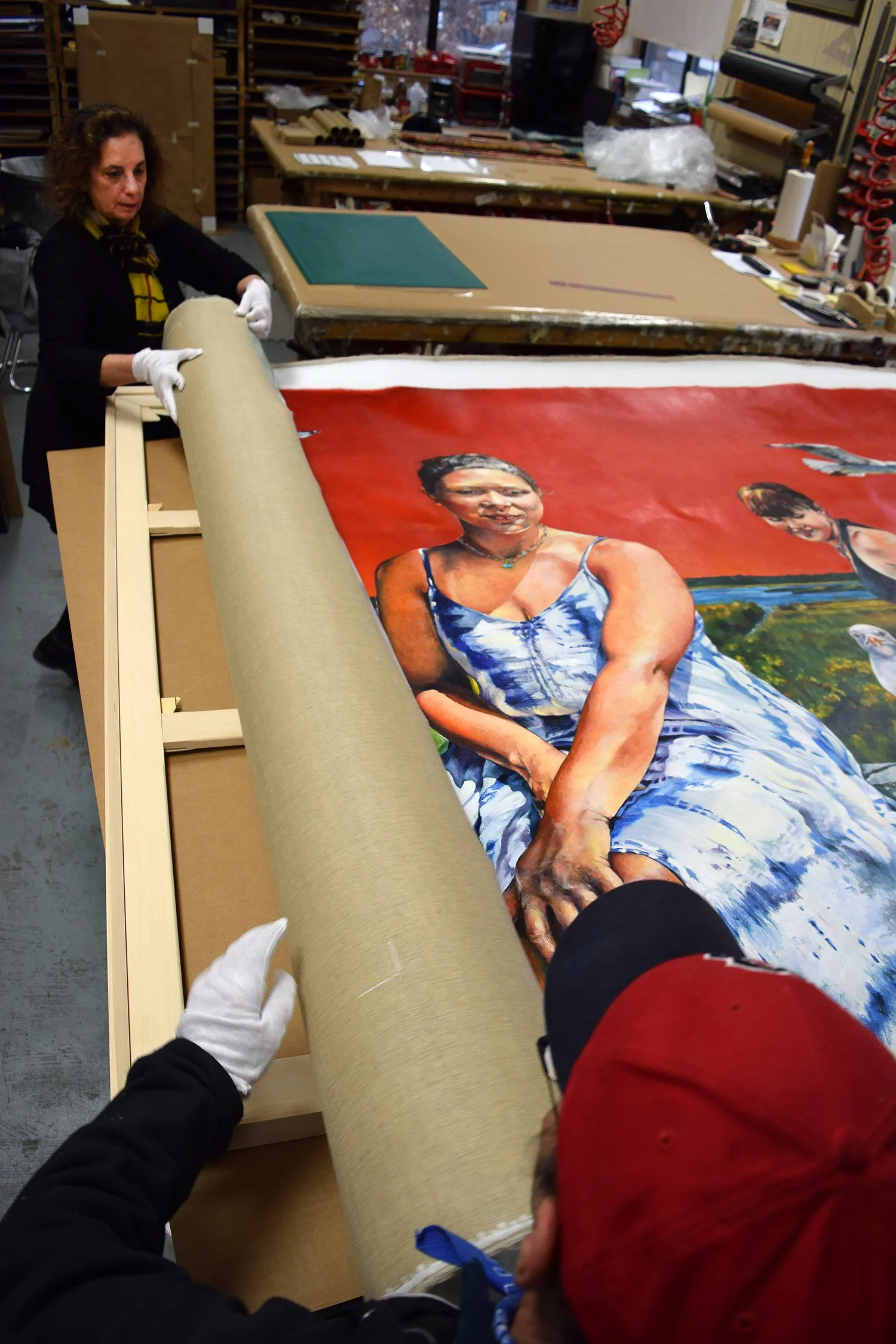
Linda H. Post is a contemporary figurative realist artist based in New England, known for her richly pigmented and enigmatic paintings of powerful women, the sea, and uncommon places. Her dreamlike works blend landscapes, seascapes, and architectural elements from her childhood on the New England coast and her time in western Massachusetts to create surreal, narrative scenes.