5 Questions For Dr. Samuel Peralta
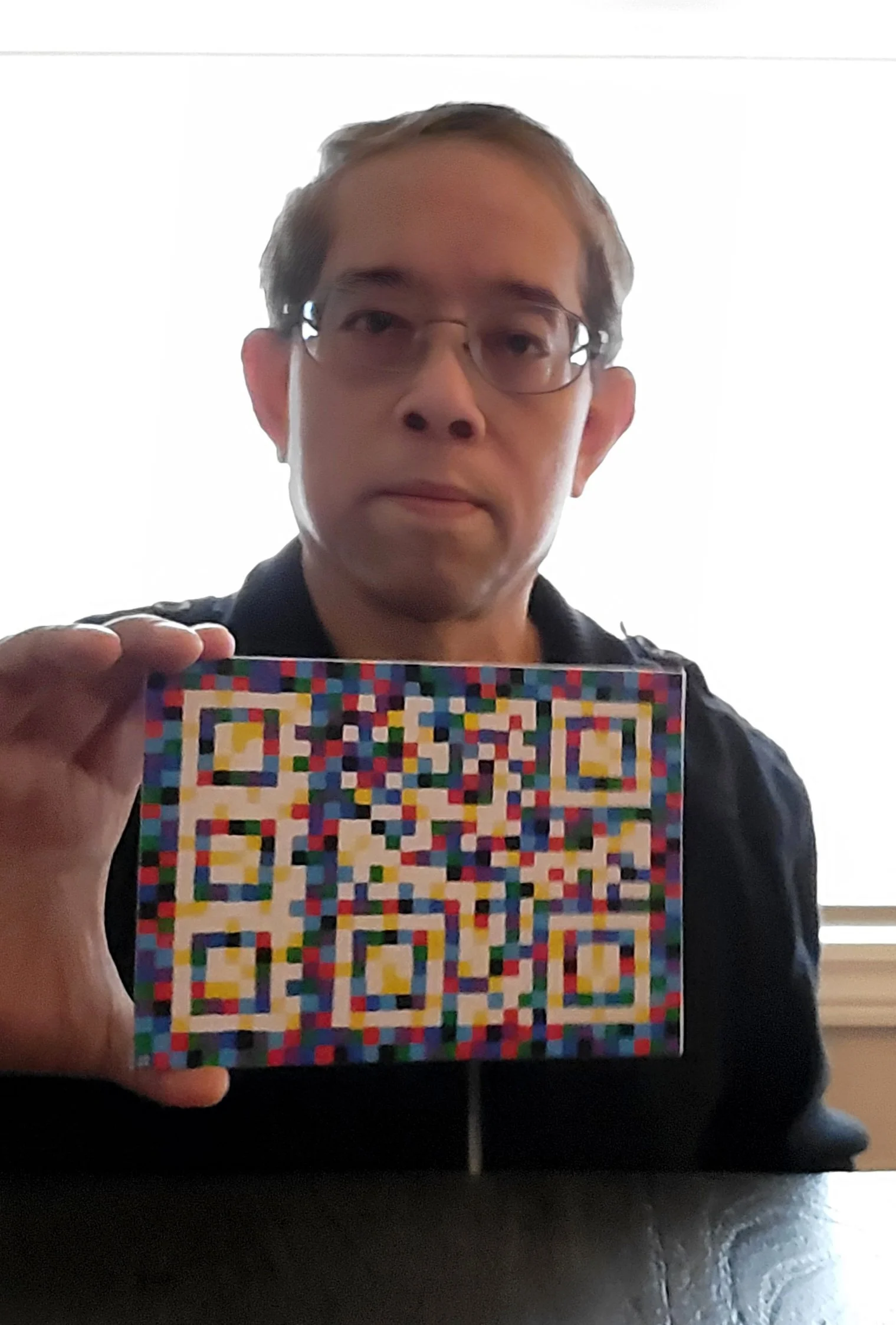
Sam Peralta is a conceptual artist whose work merges his award-winning poetry and visual art using a human-machine symbology. His Augmented Visions series embeds poetry onto a visual composition using QR code. Each art piece can be appreciated as an mechanistic twist on neoplasticism; the works have the discipline of De Stijl, the modernist movement spearheaded by such artists as Piet Mondrian.
Viewed through the lens of any smartphone camera, however, built-in software reveals a hidden meaning transforming the artwork into something more, a revelation: the work’s title and the decoded lines of verse form a complete and evocative poem.
Trained as a physicist, Peralta’s previous artistic experiments – using Markov algorithms as the basis for generative art, or a human-AI collaboration in poetry – have evolved into this symbiosis of art, poetry, and augmented reality. It raises questions about meaning in art when it depends not just on human perception, but also on a level of reality accessible only via machine.
Your work on Artsy features your Augmented Visions series, which requires a smartphone camera to scan embedded QR codes and unlock lines of poetry. How did you land on this mechanical, tech reliant approach to experiencing fine art?
I’d been writing poetry and fiction all my life, and while I loved visual art as a collector, I only drew and painted on occasion. While most of my collection was of realist art, I’m also drawn to the colourful surrealism of Miro, the paper cut-outs of Matisse, and the disciplined plasticism of Mondrian. Early on, I emulated the latter by making works of square grids, determining their colour by probability – tossing coins or throwing dice. Later on, I realized that, instead of random colour generation, I could encode words in my art by using QR codex. That realization of a synergy between my poetry and my visual practice was the aha moment for Augmented Visions.
In a world currently anxious about the role of technology and AI in art, your Artsy bio describes your method as a “human-machine symbiosis”. How can artists learn to collaborate with machines rather than fight them?
I call it a “human-machine symbiosis” because while you can appreciate my art with the naked eye, you can’t get a full appreciation of it without looking through ‘special glasses,’ so to speak – the QR decoder on your smartphone. With respect to working with new technologies, there’ll always be two kinds of artists – whether that technology is synthetic-hair brushes, spray guns, digital cameras, or AI – so I don’t really see the need to convince the hesitant artist otherwise. The next evolution of art will be made by those who embrace the new. In time, the new technology – like acrylic pigments or digital tablets – will find its place as part of the art mainstream.
You are widely respected as an active collector and have curated exhibitions with 33 Contemporary Gallery. How does your internal mindset shift when you switch from analyzing other people’s artwork to producing your own canvas?
I’m the audience for other people’s artwork. When it’s my own work, at some point in the process, I have to put myself in the shoes of the viewer. It’s exactly like writing poetry or fiction. For my first draft, I write for myself; but for the next draft, I have to consciously think of the audience. What emotion do I want to instill in the audience? What message do I want to convey? When I view art, I perceive it as the audience. When I produce my own work, I have to imagine what that audience might perceive.
You were featured in the documentary process for “The Art Side of the Moon”. What was it like being on the other side of the lens, having your own monumental project chronicled by other filmmakers?
By the time “The Art Side of the Moon” was filming, the Lunar Codex had already been the subject of scores of print, radio and television interviews. That made me relatively relaxed in front of the camera. Another difference was that instead of a one-minute spot, I was given a broader latitude to talk about the project, and so I was able to spotlight not just the technology used, but also much of my personal collection of art, which makes up the initial selection in the Codex archives. It’s always thrilling for a collector to talk about the works they love.
If a young student is feeling torn between pursuing a career in STEM versus a career in the humanities, what wisdom would you share with them based on your life path?
Firstly, I’d advise them to make sure they have an aptitude for either the sciences or the humanities. It may be difficult to become a professional singer, for example, if you are tone-deaf, or to become a physicist if simple algebra defeats you. Having said this, for those who have the aptitude for both technical and humanities-oriented careers, this would be my message: Why not both? I’ve been able to pursue both passions – and the way I achieved this was to pursue science as the foundation for a financially successful career, while passionately practicing the arts in any spare time I had. It’s more difficult to do the other way around. The result is that different communities know me as a physicist, a writer, an inventor, a musician, a programmer, an artist – and all of them would be right.