5 Questions For Katarzyna Adamiak-Jaśnikowska
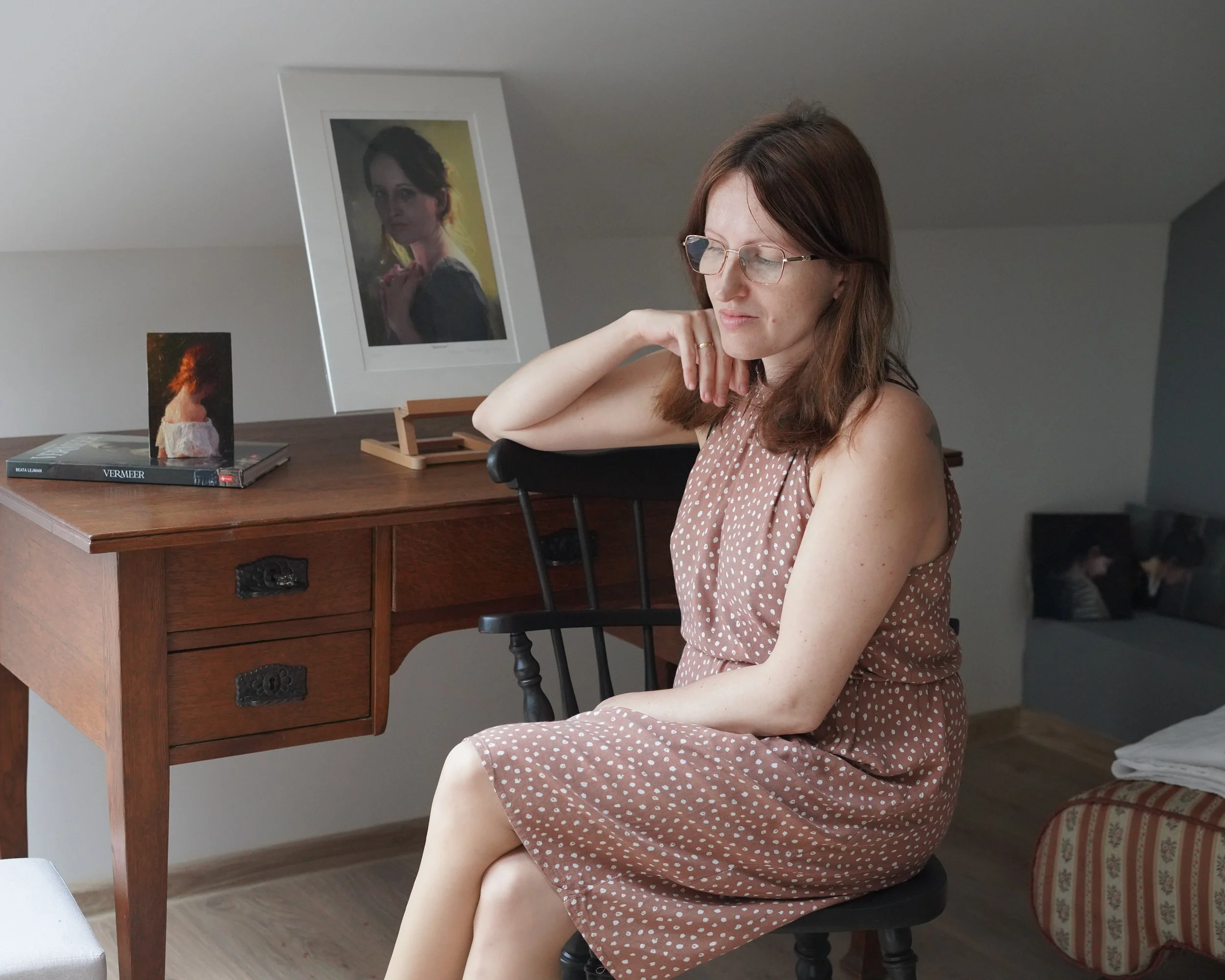
Katarzyna Adamiak-Jaśnikowska (b. 1985) is a contemporary realist painter specializing in traditional oil techniques. Her work focuses on the human figure and portraiture, with light serving as her primary creative force. She crafts intimate, atmospheric portraits rich in personal and emotional depth, carefully selecting her subjects to establish a deeper connection with the creative process.
Self-portraiture is a recurring theme in her work, offering a means of introspection, self-expression, and documenting internal changes over time. Through these pieces, she explores her emotions, thoughts, and evolving identity.
Adamiak-Jaśnikowska has been a finalist in numerous international painting competitions including the prestigious Art Renewal Center (14th, 15th, 16th, and 17th editions) and Modportrait (2017, 2019). Her work has been exhibited in galleries and museums in Europe and USA . Additionally, several of her paintings are digitally preserved in the Lunar Codex, an international collection of contemporary culture placed on the Moon in three-time capsules. Her works are also held in Private collections in Poland and abroad.
How do you select the subjects or models you paint?
I usually find my models among the people closest to me: my family and friends. I am also a mother of two boys, aged nine and five, and I increasingly feel drawn to making them the subjects of my paintings. I try to capture the distinctive world of childhood that surrounds them. As I watch my sons, I sometimes find, in seemingly ordinary moments, a subject I feel is worth preserving on canvas.
I also love painting self-portraits. For me, they have always been a kind of journey inward.
What I love most is when a subject simply presents itself. I do not have to look for it. Suddenly, there is a moment when the light, a gesture and a mood come together, and I know I want to paint it.
How do you relay emotion in your work?
My paintings are simply a part of me: my own story and, to a large extent, the people close to me. Rather than seeking out darker emotions, I am drawn above all to light and harmony.
I devote a great deal of time to the composition, finding the right balance of tonal values and beautiful colour relationships. I want the painting to guide the viewer’s eye with clarity.
But I think it all begins with the pure, childlike joy of painting and a sense of wonder at light, which gives me the impulse to create.
Which colors must you have in your palette before starting a painting?
My favourite palette consists of around fourteen colours that I find it hard to do without. It must include three yellows, as well as cadmium red and carmine. I also love cerulean blue, which is wonderful for mixing skin tones.
Lately, I have also been working frequently with a more limited palette, such as the Zorn palette, or exploring different combinations of the three primary colours and white. I enjoy using a limited palette because it makes it relatively easy to achieve colour harmony throughout a painting.
What was your breakthrough artwork and tell us what happened after?
I consider my 2020 self-portrait “Glance “, to be the turning point in my work so far. It brought together everything I had learned about painting up to that point, while also showing me the direction, I wanted to take in my work. The painting came together very quickly. I could say it simply flowed out of me, naturally and effortlessly. I painted it in just five days. I was also very proud when it was selected as a finalist in the portrait category of the 16th Art Renewal Center competition.
How has your style changed over time?
My style has evolved along with me, as I have changed and matured over the years since I began painting. Early on, before I found my artistic direction, I experimented and explored a great deal. Yet I was always drawn to realism. I felt a need to observe my surroundings closely and depict them in a realistic way. Later, my interest in Byzantine icons, both in their theology and in learning the practice of icon painting, led me to focus on portraiture (although I have never formally reference icon painting).
One thing in my painting has remained constant: my sensitivity to light. Light has always been profoundly important to me, and it remains the driving force behind my work.