5 Questions For F. Scott Hess
Your Face or Mine: Collectors | Paintings by F. Scott Hess
The critic Donald Kuspit noted that you use "profane realism" to capture sacred moments in a secular world. How do you personally identify a "sacred" moment in the middle of a messy, everyday scene?
I wouldn’t term it a sacred moment. In narrative painting time has to be telescoped into one instant that expresses the thrust of the story. I construct an image that carries the meaning I intend to convey, the essential elements of my ‘story’. Most of my paintings involve people interacting with other people, and there are expressions and gestures we humans have learned over millennia of our social existence. I try to use those because we understand them before our conscious mind sets to work interpreting content. You ‘feel’ the meaning of the piece before you think about it. Gut-level.
Of course, the abstract elements of painting play a huge role: light and dark, color combinations, brush-stroke, texture, etc, add to delivering the intended content. They work the same way, at a gut-level. They invoke moods and emotions in the viewer.
More specific intent can be delivered through cultural signifiers: shared elements from history, myth, or current events; symbolic signs or objects; clothing or objects with symbolic colors, etc. These are sometimes read by the viewer subconsciously, but usually take some conscious thought to interpret the intended meaning.
Through this a narrative moment is built, but I rarely want it to lead to one specific ‘message’. I try to control the viewer’s mind up to a specific point, head it in an unexpected direction, then have several possible endpoints. The narrative doesn’t close. An easy ending would kill the painting.
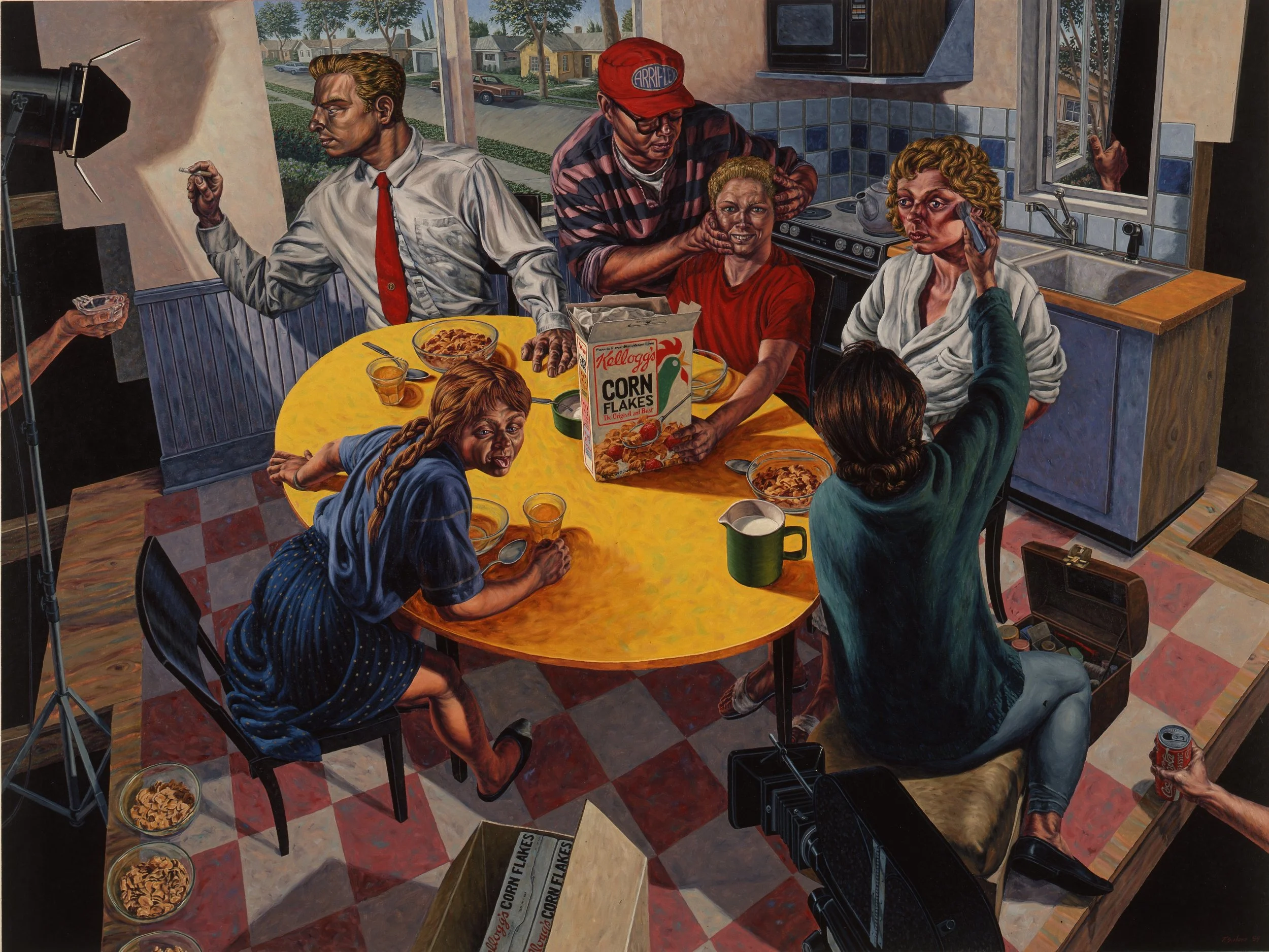
F. Scott Hess | Cornflakes 1989
You have mentioned that the banality of everyday human experience is incredibly terrifying. How do your color palettes-like under-painting flesh with purples and greens-help expose that underlying dread?
Human beings are capable of amazing endeavors, in the arts, sciences, even governing, but always the banal in our nature steps in and destroys what we’ve accomplished. The banal lacks a sense of the broader view. Hyper-focused on the superficial, and immediate gratification, it can’t take in more complex human contexts. It doesn’t understand WHY something is how it is. Banality is confined by the expected, by predictable patterns.
How do humans escape this repeating chain of destruction if we are, as a species, incapable of imagining something different? If the implications of our banality don’t terrify you, it should.
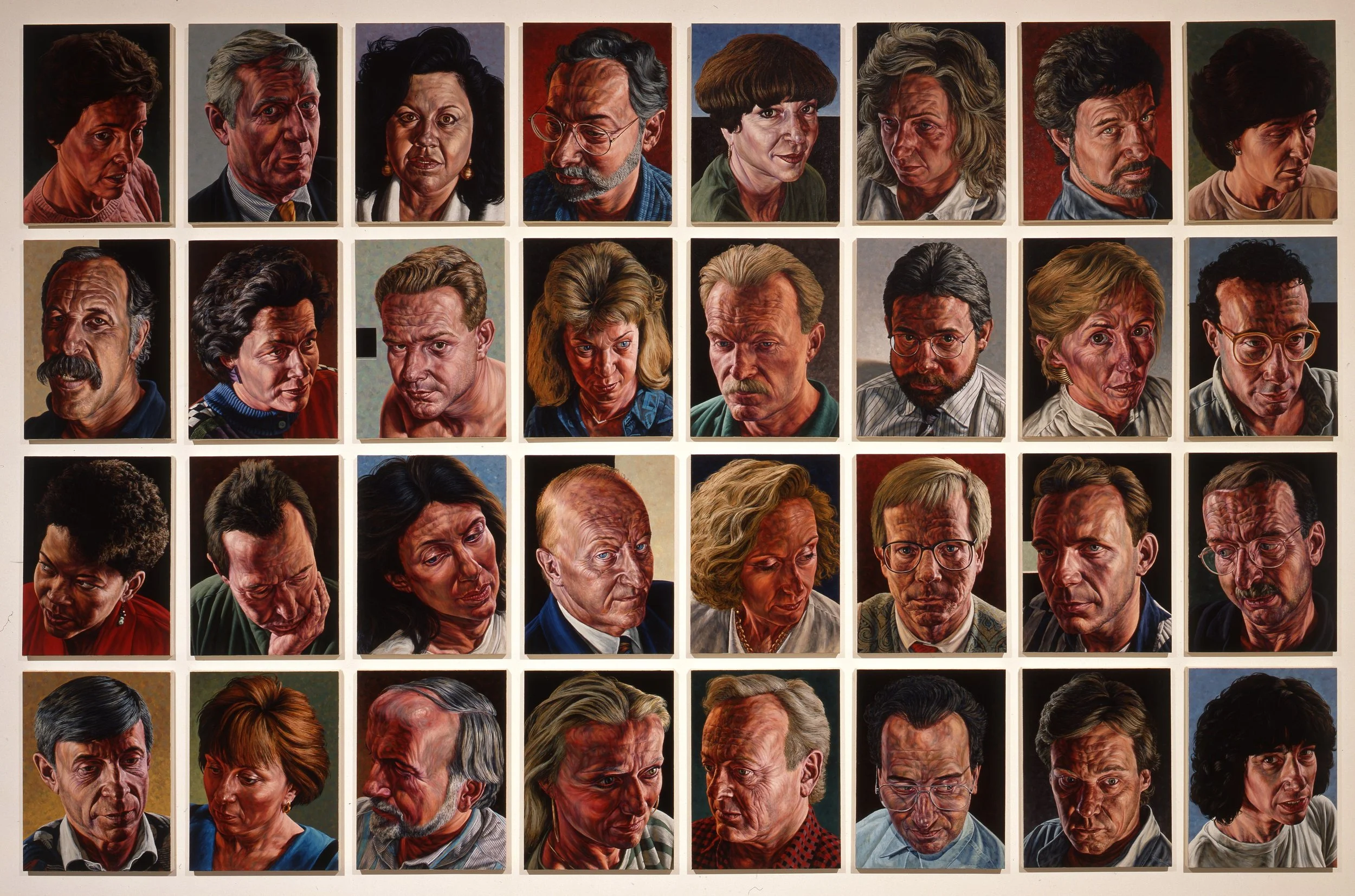
In earlier paintings I tried to deliver color that conveyed my thoughts on human foibles through grotesquery. The purple and green underpainting in flesh is an example. It made my humans look bruised. Evident paint strokes made their skin crawl. Alternating strokes of color made the painting vibrate like a seething cauldron.
In later works, the color works differently. It is almost like over-sweet candy. At some point I thought, ‘horror can happen under a sun-filled blue sky in a field of yellow flowers.’ The paintings looked brighter, pastel colors that felt pleasant, but the actions in the painting were still meant to disrupt, to disturb, to leave the viewer in an unsettled state of mind. I’d rather get a “WTF?!” reaction than “it’s beautiful.” That is not to say I don’t see my work as beautiful. I do, but that beauty is aimed to lure and confound.
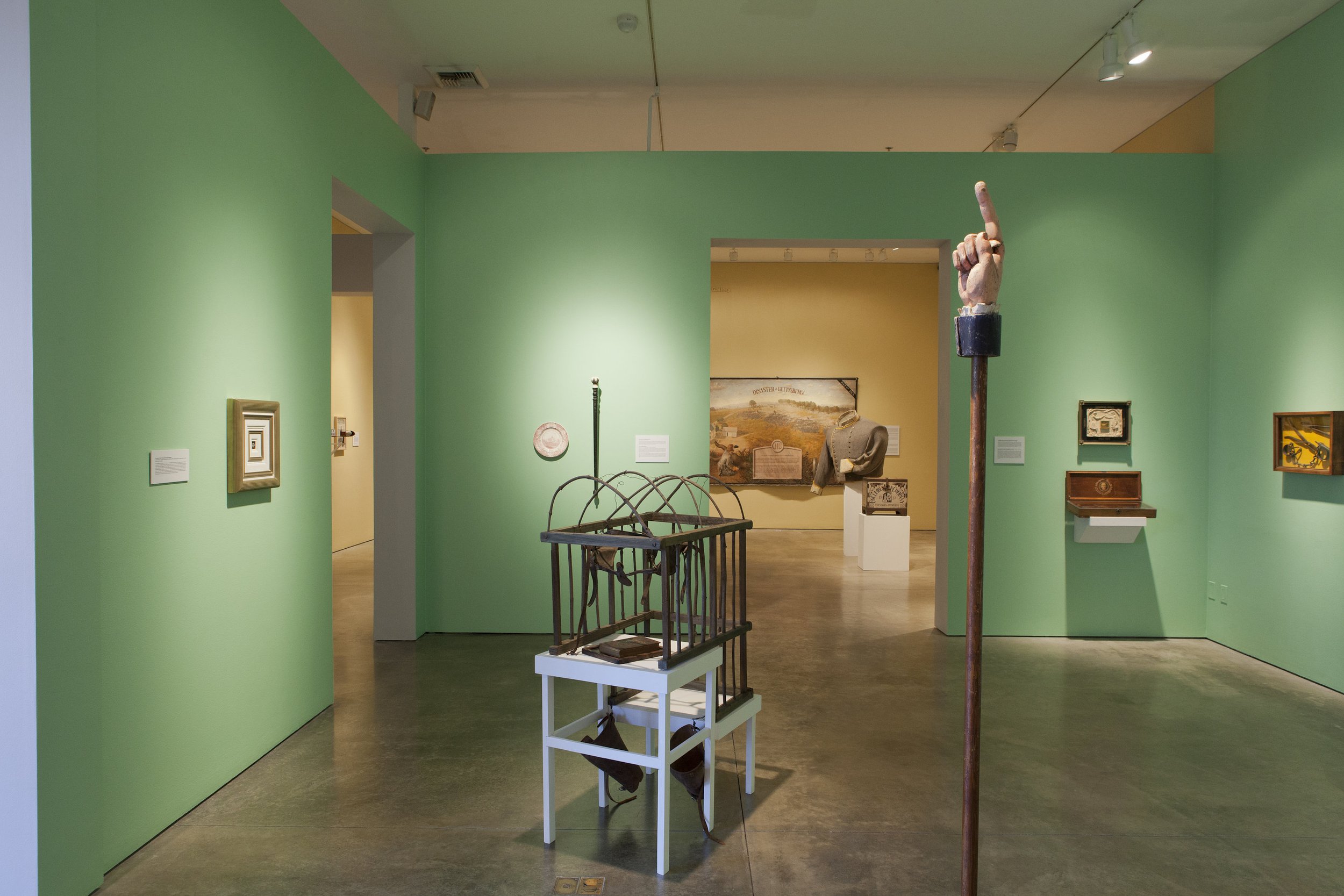
Installation View, The Paternal Suit: Heirlooms from the F Scott Hess Family Foundation, Long Beach Museum of Art, 2014.
For your famous exhibition, The Paternal Suit: Heirlooms from the F. Scott Hess Family Foundation, you stepped away from direct authorship and took on the title of "Director". What did blurring the lines between real historical artifacts and fiction allow you to say that a straightforward painting couldn't?
The Paternal Suit was my most popular exhibition, touring five museum venues. I tried to get my painting retrospective to tour couple of years later, but with no success. Why? I think my paintings express a more interior, personal vision, maybe more mysterious and unreadable to an audience. The Paternal Suit held up a mirror to American democracy, nation building, and shared familial engagement in that endeavor. The most common response from viewers of that show was a sharing of their own family history, and a desire to learn more about their own ancestors. It opened a door to their own curiosity, whereas my paintings take to viewer to a darker, more complex and confusing place. They were never meant for a broader audience, but meant for those few who could relate to their content because their souls run parallel to mine.
My paintings are important as my most personal expressions. I can’t say they were usually ‘fun’ to make. It was work that had to be done to see the vision in my head realized, pushed out into the world. They were fulfilling.
The Paternal Suit took six years to realize. I think I spent most of that time in the studio laughing. The pieces are full of dry humor, a kind of wicked joy, a feeling that I was creating a monumental joke on museum seriousness, on American belief systems, on the ancestral line of the father who abandoned me. Fun doesn’t begin to describe it.
The Paternal Suit stems from being abandoned by your father at seven years old. Did constructing a massive, fictionalized paternal lineage offer you any personal closure, or did it highlight the absurdity of family myths?
The paternal lineage wasn’t constructed. The Paternal Suit was backed by years of research, both historical and genealogical. I discovered a paternal lineage with thousands of names, that did help fill the vacuum of abandonment left by my father, but it was the construction of the narrative of paternal history, through a fictionalized set of artists and artifacts, that settled the issue (as much as it can be settled).
Many of these ancestors were not good people, but none would have thought of themselves as bad people. Those that came and killed the native population, to steal their land, presented a moral or religious rationale for their actions. Slave holders presented racist and religious arguments for their ownership of other humans. Military ancestors believed in their moral superiority while leading their own men to slaughter. Politicians battled for their own interests, and those of their supporters, without a second thought as to whether it was good for their country, though they presented these issues in patriotic terms.
In The Paternal Suit I tried to highlight the hypocrisy and absurdity of my ancestral lineage, mirroring perfectly the growth of the American Republic. I mixed fact and fiction, keeping to historical fact as much as possible (is it possible?) and using fictional artists and objects to illustrate the absurd contradictions inherent in such a narrative. What I did not expect was that in less than a decade, this absurdity would become the norm in the flow of our shared daily existence.
You've contributed to discussions regarding what artists should ask prospective dealers. What is the biggest mistake you see young artists make when navigating commercial gallery representation for the first time?
This is a hard question for me at this time. I’ve pulled back from the business aspects of my creative endeavors. It always bored the pants off of me, but was necessary to continue an existence as a working artist. Now that I’m older, with some earlier investments paying off, I don’t need to do the business dance. And I no longer know much about the current gallery scene.
A while back, when I was asked what advice I’d give young artists, I said “Marry rich.” Still useful advice, I think.
To get to the specifics of the question about navigating gallery representation: 1) Build your own network, don’t rely on the gallery to do this. Your career will probably outlast the gallery that first takes you on. You don’t want to be left hanging if the gallery goes belly up. I’ve been there. It takes a while to recover what was lost. Get names and addresses of collectors. It is your right. Build your email list and keep it current. Cultivate curators and art professionals. The existence of most galleries is even more precarious than an artist’s existence, so plan for the long term.
2) Your dealer is not your buddy. Be friendly, but never forget this is a business arrangement. You can ask a friend to do things you’d never ask of your bank. Friendship can be used as leverage. It is not your job to finance the gallery, much less the dealer’s lifestyle.
I wish I could say the secret to a successful career is to be true to yourself, make work that excites you, kicks everybody’s ass, etc, but the need to pump stuff out on social media has kind of wrecked that possibility. It seems necessary to be prominent on Instagram, and the work has to grab a mass public’s instant attention, hold it for three seconds, and get a ‘like.’ Get enough likes on enough posts and you build a following of thousands, then galleries want you. Maybe that beats going around to galleries with a handful of slides… less face to face abuse… but there is also a lessening of art as a whole. That three second look dumbs down art. The methods that worked for me, finding a few collectors of like mind, who observe a work slowly and carefully, and then buy the work through the gallery, don’t seem viable in a world where success involves a massive social media following.
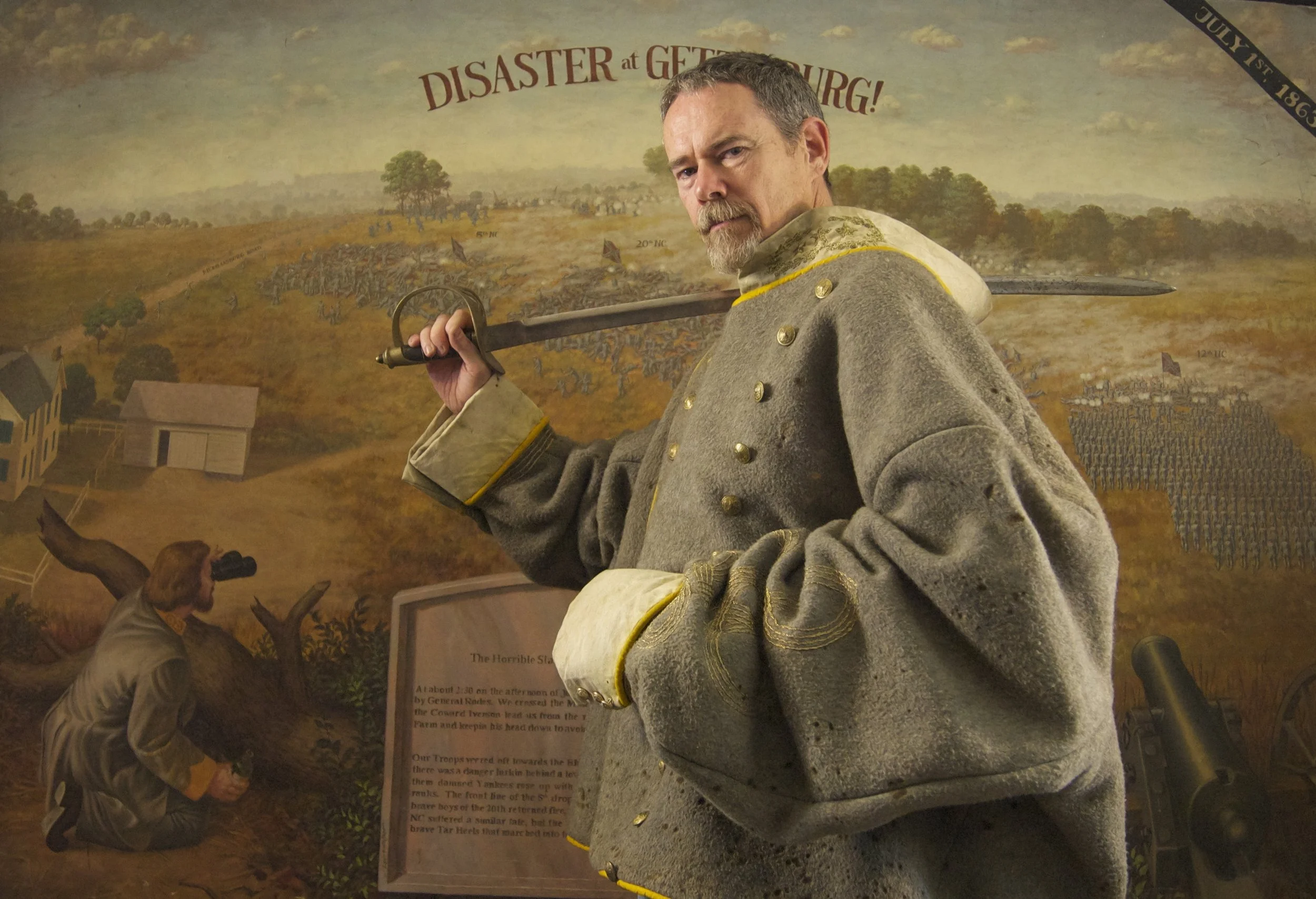
F Scott Hess wearing CSA Brig Gen Alfred Iverson’s Calvary Jacket.
F. Scott Hess (born July 12, 1955) is an American painter and conceptual artist. He has described himself as a "reluctant realist" whose work is nevertheless grounded in Old Master craft and the representation of observed detail.