• NEWS
  • ABOUT
  • DOWNLOAD
  • SOLD 2026
Menu

PoetsArtists

Street Address
City, State, Zip
3098386657

Your Custom Text Here

PoetsArtists

  • NEWS
  • ABOUT
  • DOWNLOAD
  • SOLD 2026

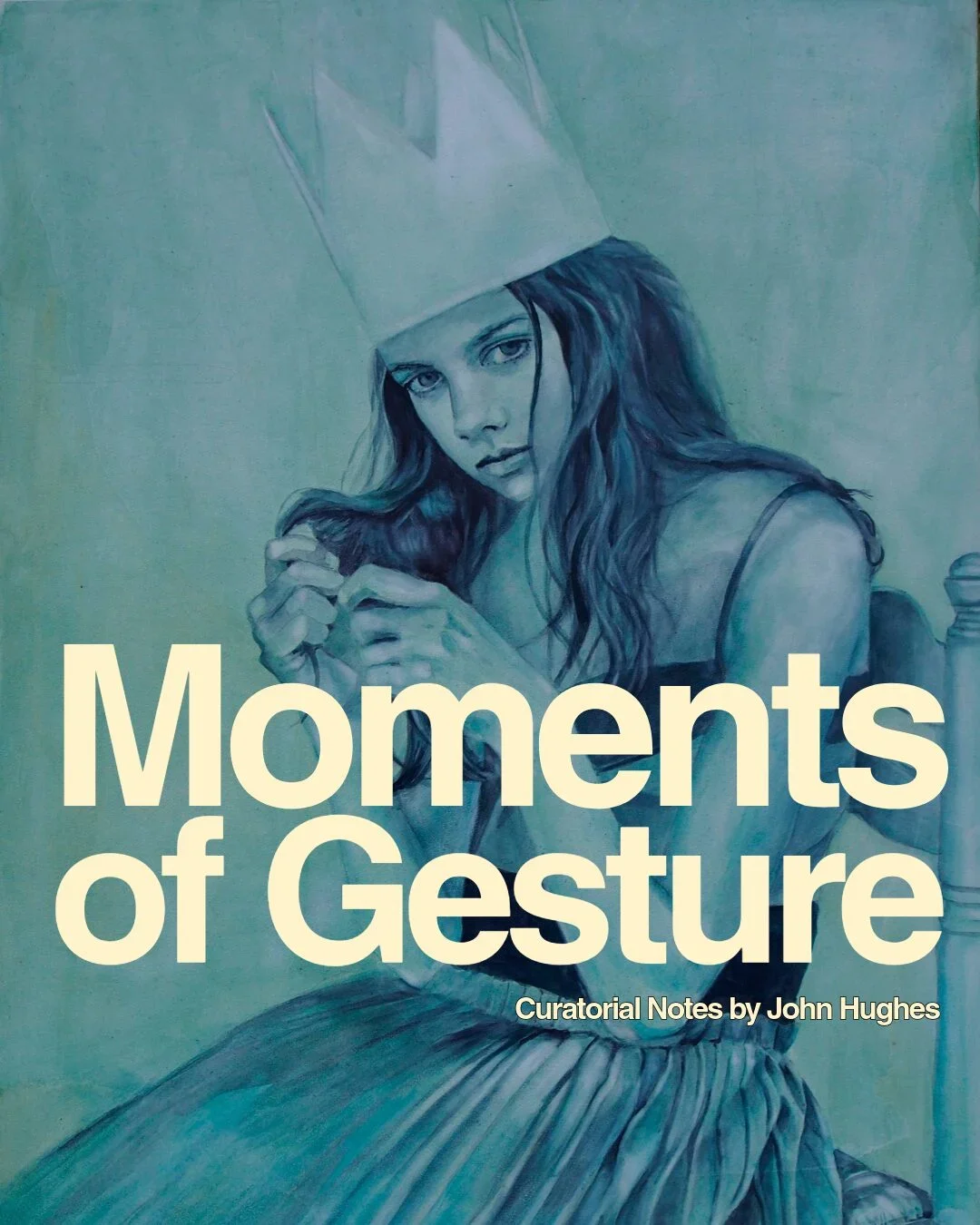
Moments of Gesture by John Hughes

June 5, 2026 Didi Menendez

Valentine Aprile

A Meditation of Place, 2026

Oil on loose canvas (not stretched)

36 × 48 in | 91.4 × 121.9 cm

As compared to other arts, unlike video or movies, painting does not involve motion.  The painting is a single frame.  However, within that frame can be produced the sensation of motion through gesture.  The painting compared to sculpture, statuary, lacks depth in three dimensions.  However, the painting can compel the illusion of depth due to the technique of the painter.  The painting unlike music is silent.  But this silence affords a spatiality for meditation on the other senses, specifically vision, and all of the implications of what is seen.  Less abstract than a poem, which works through the symbols of words, painting may still alternatively dissolve photorealistically into its subject or foreground itself as paint, the brush-stroke, the pigment declaring itself.  Unlike reality, which flows in time, painting is a frozen moment, and yet, as a moment of gesture, it implies time, and allows an examination of the moment as if the viewer were freed momentarily from the drift of time and allowed to stand outside of it and peruse the moment as if it were a mayfly frozen in amber.  The painting is a simulation, a simulacrum, and yet has its own originary status, declaring itself as itself, as painting, as gestural act, even as it may dissolve and lose itself into the imagery of what it portrays.  

Daggi Wallace

The Offering, 2026

Charcoal, Acrylic on gessoed cradled wood panel

12 × 24 × 1 1/2 in | 30.5 × 61 × 3.8 cm

What is the moment of gesture?  It is to begin with, an act of the attentiveness of the creator, the artist, the painter.  Yet the artist dissolves into her tools and would be the first to tell you that it may not be herself that makes her painting, but something that works through her.  We have an image of the artist lost in concentration, absorbed in the process of creation.  This absorption is important.  From the artist’s point of view, it may be a necessity; it may feel like a therapy, a way of healing, of processing life; it may feel like a discipline, a craft, satisfying, like knitting.  If the craft is fine and the moment fortuitous, this absorption, this mild trance, may also occur in the viewer of the painting, as they recreate the painting in their mind, by viewing it, appreciating it.

The paintings in this selection are bright and alive with color.  They are precise and suave with craft.  At times the paint declares itself abstractly as pure pigment.  At other times the paint as if disappears into a cheek, an eye, a lifted hand, and what is felt overwhelmingly is the image, the figure of the model, the portrayal.  Sometimes the painting recedes into being the flat surface of cleverly applied pigment which it is.  Other times it opens out into a depth, and one is suspended in transport, a feeling like watching a good movie, where what one becomes aware of, is coming back out of the painting, the absorption in it which has then occurred.  

The human figure is essential to these works.  After all, we are biologically and evolutionarily optimized to read exquisite minutia of the expression of a face, the bend of a hand, the aspect of a body.  Friend or foe?  Who is this?  

John Hyland

Primavera, 2023

Oil on canvas

12 × 9 in | 30.5 × 22.9 cm

There is a human community to these painters and artists.  They are all alive at the same time we are.  We float in our little bubbles of self through a shared-for-a-while space and time.  We might as well get to know each other while we’re here.  The meditative space within which the moment of gesture of a painting arises is where we may know.

There are more artists involved in this than just the artists who make the art-works.  The viewers are artists.  As they regard the painting, they recreate it in their minds, as it becomes what it is within their reactions.  Those who love art are artists as well, only in their own ways.  Ideally art helps us remember how all is art.   Making the painting is art.  Looking at the painting – at least doing it successfully – involves a certain art of looking.  Searching for and locating these artists and getting them together in a shared space is an art.   Dulce Menendez, who oversaw this project, agreed when I asked her:  “Publishing to me is an art form.”  And that is the magic of art, when it works.  It leaks through your life and perhaps affords you at times the grace to glimpse that all is an art from, all is a painting, from the morning sunlight through the kitchen window, to the sound of the mockingbird, sip of this cup of coffee as I type these words.

The artworks in this gathering were selected for nothing other than their flagrant beauty and subtle implications.   - John Hughes, June 2026

Moments of Gesture

June 1 – December 31, 2026

Presented by 33 Contemporary

Curated by author John Hughes for the 33PA community.

Learn more
Source: https://www.artsy.net/show/33-contemporary...
In American Art Collector, ART COLLECTOR, Art Review, Artist, Contemporary Art, Contemporary Figurative, Essay
Comment

Interview with Elizabeth A. Sackler

June 23, 2019 Thomas Wharton
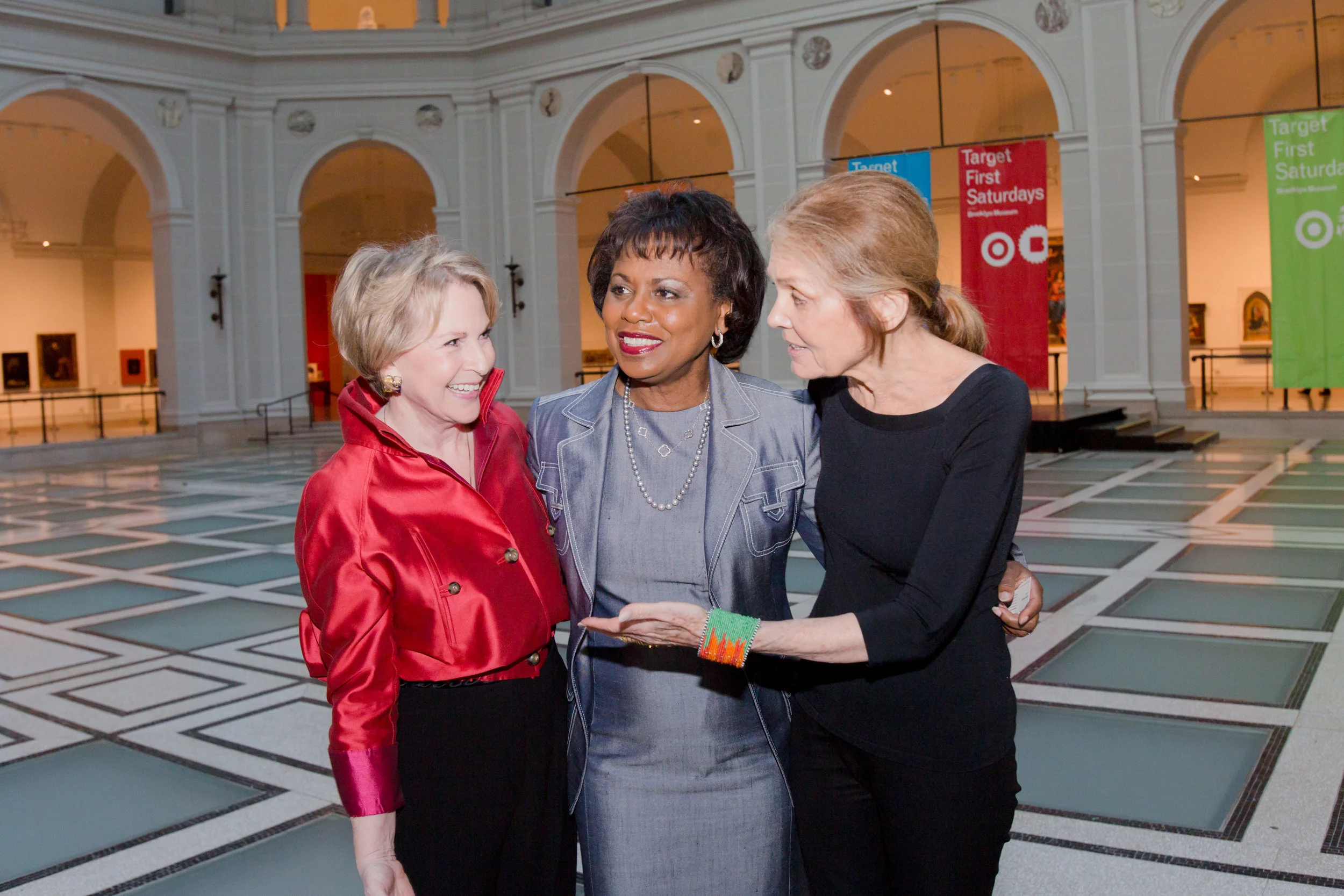
Elizabeth Sackler and Gloria Steinem with 2014 Sackler Center First Award Honoree Anita F. Hill. Photo credit: Elena Olivo

Elizabeth Sackler and Gloria Steinem with 2014 Sackler Center First Award Honoree Anita F. Hill. Photo credit: Elena Olivo

On April 25, 2017 I sat down with one of my Sheros, Elizabeth Sackler, an activist for social justice, equity and equality. Elizabeth is deeply involved in the social justice communities and adds fuel to far reaching feminist action.  She is the founder and president of the American Indian Ritual Object Repatriation Foundation and the visionary and impetus behind the Elizabeth A. Sackler Center for Feminist Art at the Brooklyn Museum. As Judy Chicago says, ‘Elizabeth Sackler is a force to be reckoned with’. After a warm welcome we jumped right in.

VS: The ‘New Feminist’ issue of PoetsArtists wants to tap into what’s happening on the New Feminist frontier. The work being done at The Elizabeth A. Sackler Center for Feminist Art seems to be the epicenter of rising feminist action as well as feminist art. I imagine you, Elizabeth, with your finger on the pulse and hands in the mix, bringing people together, instigating awareness and change. 

ES: A lot of my work at the museum now is feminist social action oriented. In terms of feminist art in the gallery world, I don’t work in those universes.  

VS: That’s exactly why we wanted to talk to you. For me, the Brooklyn Museum is not only focusing differently than the gallery scene but you’re redefining what it means to be a museum. The way you’re approaching activism and community involvement is redefining ‘museum’. I see the Brooklyn Museum as a ‘change agent’. 

ES: Yes it is and it is because of the Elizabeth A. Sackler Center of Feminist Art. I was very fortunate to have a great partner in Arnold Lehman who was the Brooklyn Museums director at the time that I brought him my idea for the Sackler Center. That vision was not for a gallery, but for a center. There’s a difference between having a gallery where you have only art and having a center where you have everything. Where you have lectures, where you have different kinds of exhibitions and where you can really break ground. That was really my interest. 

My concept was to use Judy Chicago’s Dinner Party as the fulcrum to the center in addition to offering it permanent housing. This was for Judy a critical moment.  She said, ‘Hurrah, it’s done’ and I said, ‘No, it’s just beginning.’ Because for me, The Dinner Party is a launching pad for every conversation. The one thousand and thirty eight women of The Dinner Party represents one thousand and thirty eight disciplines. There isn’t any area of life that it doesn’t touch.  It is educating us about the past women who were feminists in their own right, even though the word didn’t exist, who were really breaking ground and doing things. Many of them of course were punished for it. Many of them were killed for it. We have this horrible history of oppression and women faced it with the grit and the will and the desire. Women who couldn’t be stopped. You can’t help it. You just go ahead. Didi Menendez, would know that. If your D.N.A. is made like that, then whatever your vision is that simply has to be and if that means change, that means change. The Dinner Party for me is a launching pad for all our programs and dialogues. 

The Sackler Center layout breaks down with the Dinner Party Gallery at its nucleus, then the Feminist Gallery, the Herstory Gallery and the Forum. The Herstory Gallery is next to The Dinner Party and historically we’ve had small exhibitions there that have been extremely important. 

Catherine J. Morris, The Sackler Center’s Senior Curator, produces more exhibitions each year than any other curator in the museum. We bring forward Herstory. 

The Herstory’s very first exhibition used pieces from the museum’s Mesopotamia collection to reflect back some of the very early women in The Dinner Party, women from Greece goddesses. It was the first time in the museums history that there had been interdepartmental loan; where one department gave art for exhibition to another. That changed the functioning of the museum. It became in what academia is called interdisciplinary.  

It was very interesting because when I signed the agreement with the Brooklyn Museum, in 2001, I didn’t expect to see changes in the museum until the Sackler Center opened. And it changed immediately, absolutely immediately. Suddenly curators were looking in storage. What had they neglected, or overlooked, or put aside? Within a year of signing the agreement the museum exhibitions started to change.  

It took four years for the Elizabeth A. Sackler Center for Feminist Art to be built; we opened in 2007. The space had housed the Brooklyn Museum costume collection and the Schenck House.  So it had to be emptied. The costume collection was gifted to the Metropolitan Museum. Which is how I knew The Brooklyn was really serious about a center for feminist art!

VS: It’s amazing that while we see you breaking down walls and shifting conversations and building connectivity on the public platform you were also doing that inside the museum.

ES: And as we were doing that the museum changed and the curators changed. It was interesting because the curators were not jealous of all the focus on the Sackler Center, to the contrary, they were extremely excited because it was new energy and it was bringing life to departments that had sort of been drifting along.

VS: Sounds like you were fascinated by what other departments could offer to Herstory and they knew you wanted to tap into them and they loved that.

ES: And they were very very excited by what we were doing. 

VS: Just out of curiosity, when you joined forces with the Brooklyn Museum were most of the in place curators male or did you inherit a lot of strong women curators?

ES: There were men and women curators. Amy G. Poster, for example, was the head of Asian Art at the time a very strong curator. I don’t know what the exact gender balance of curators was. 

When Arnold invited me to join the board in 2000 there were about twenty five men and about four or five women on the board at that time.  Now we’re thirty eight and the majority are women, two thirds are women. The museums entire senior administration is women with the exception of David Berliner who just came on as COO.  The board officers are now all women. When I came on the board officers were all men. 

VS: I noticed currently at the Brooklyn Museum, perhaps for the first time in the history of any museum, the three main shows, all major current exhibitions, are all women artists. It’s so powerful.

ES: Yes, It’s a great moment. It’s a really incredible moment. We’ve always had two women shows going on in the Sackler Center but with ‘Marilyn Minter: Pretty Dirty’ and ‘Georgia O’Keeffe: Living Modern’ accompanying our ’We Wanted a Revolution: Black Radical Women, 1965-85’ it’s a full sweep throughout the museum. We’ve taken over the whole museum. That was the idea, to take over the museum.  So far so good. 

VS: While you were making all this happen has there ever been a moment when your jaw dropped because you were actually watching feminist progress being made right in the room where you were sitting?

ES: I think what dropped the jaw for me was how rapidly the Sackler Center had external influence. It was within months of opening. I hadn’t expected that we would have such an impact internationally, for galleries, for women artists, for feminist artists all of a sudden.  There’s still not parity, as we know, but the improvement has been significant. Of course I watched as immediately the Whitney started looking and the Guggenheim started looking and the Met started looking. You can see that it’s changed. It’s changed, but we still have more to go. It wasn’t so much jaw dropping but it surprised me how quickly it happened. I thought it might take a year or two. I didn’t think it would take a month or two. Well it just goes to show you how hungry everybody is for women’s work. It really has less to do with the fact that maybe I had an impact by coming up with something.  More it shows that there is an audience who is really hungry for this work. It taps into that. People really want it.  

VS: We know how important it is for global solution seeking to get women’s voices into every arena right now.

ES: Well that’s true we have a long way to go. 

VS: You work on that every week, every month every time you do a program. 

ES: That was very important to me. That is why we created the Forum in the space too.  We have The Dinner Party Gallery, the Herstory Gallery, The Feminist Gallery and the Forum. I wanted a space that would seat about forty or fifty people. The Brooklyn Museum auditorium seats four hundred. I knew that we would have a lot of programming, that was going to be very important, and if you have a hundred people in an auditorium that seats four hundred it looks like nobody is there.  So we have our Forum. The museum at the time didn’t understand the importance of programming to the Sackler Center. The Sackler Center programming to me was always integral. Because the museum didn’t understand the import it actually gave me leeway the first year I was out there every Saturday and Sunday doing programming and inviting people to speak. I was basically curating the programming and all of a sudden the museum looked up and realized, wow, Gloria Steinem was in the auditorium and it was sold out, and talking about sex trafficking, and we’ve got something going here. The programming now is integral to the museum. Rebekah Tafel and I continue to do the social action portion. Our ‘States of Denial: the Illegal Incarceration of Women, Children and People of Color ‘ started almost four years ago, before mass incarceration and state sanctioned violence was headline news.  

VS: I see a great photo on your desk of you picketing…it looks like you have always been an activist.

ES: Oh my gosh, that’s when I was 15. We were picketing the FBI building for voting rights in Selma Alabama. I grew up as an activist. I went to The New Lincoln School up in Harlem on 110th street my whole life. It was all about civil rights and social action. My parents were about equity and equality, moral and ethical action. I was brought up to do this. And because my father and my family had so much to do with museums I was able to watch my father negotiate and deal with museums so that I was prepared to negotiate with the Brooklyn Museum. I watched my father do it for decades.

VS: While watching him your brain must have been firing on how to bring the two together. Bringing social action to museums.

ES: I knew how to do it. I watched him do it. It’s like anything else, you have to be trained to do something so that it really works and I was well trained. I’m not a philanthropist. I consider myself a human rights activist with means.

VS: So you are a ‘firsty’ yourself.

ES: Yes, I guess I am.  Definitely. 

VS: How do you respond when women question if feminism is outdated?

ES: Nobody has ever said to me that feminism is outdated. The world that I live in is a world of feminists and feminist artists. But it was very interesting, on January 12, 2017, there was a panel discussion at the Museum of Modern Art just before Trumps inauguration. Catherine Morris, our wonderful curator whom I adore and I love working with her and we’re very close, was speaking. She had said before the election she had started to wonder whether or not we needed a center for feminist art. Then she said ‘but clearly we do.’ And everybody burst out laughing. I raised my hand after a little bit and I said that’s why I created the Sackler Center to exist ‘until we live in a world of equity and equality and justice’.  I never doubted the need for it.

I think there were generations of women and young women who felt that we had reached post feminism. Catherine, even was wondering about it.  And that sort of surprised me, but that’s cool, that’s fine. What I have adored about Catherine is what she has brought to the Sackler Center. When she came she asked ‘What do you want me to do?’ ‘what’s my mission?’. And I said, ‘We’re ahead of the curve, we’re writing the canon, we are breaking new ground and I want you to make sure that we stay ahead of it.’ MOMA and the Whitney and the Met and the Guggenheim all have money and we did not. But we have something they do not have and that is a commitment to community, a commitment to diversity, a commitment to taking risks. They have different commitments. Catherine keeps us ahead of the curve. How she has, and with the grace and intelligence that she has, is by opening the dialogue to not just feminist art as a category but what is the content of feminist art, what is feminism and what is feminist in art that we don’t see because we’ve been trained to see through patriarchal eyes. Even going back to classical times, in Egypt and in Greece, there is the power of women and we don’t see that. We’re not taught that in art history. It doesn’t take that point of view. So Catherine has really broadened the conversation about feminist content, and what it means to have feminist content. Our current exhibition, ‘ We Wanted a Revolution; Black Radical Women 1965-85’, is absolutely outstanding. We have completely busted open art history with this exhibition. To have black women artists, who in the 60’s and 70’s were already moving along in new directions, breaking ground, who often not even to this day, were not included in art history. It’s like Hanson not having any women in their art history until the 1980’s. Black women artists have been continuing to suffer from the same lack of inclusion and in fact omission and erasure. So what we are doing is exciting.  

VS: These certainly are interesting times. With the social and political upheaval people are really starting to open their eyes. It has increased empathy and people want to reach out. But at the same time there are all these other walls being built perhaps between half of the women in America. How do we include them, bring them into the conversation?

ES: I haven’t the foggiest idea. This goes back to the Reagan era. Civics was not taught after the Reagan era in public school education. As a result we have a citizenry, no matter what color, no matter what economic background who went to school and did not ever learn how the government works, what the different parts of government are, how checks and balances work and what our civic responsibility is. As Obama said in his closing statement the Constitution is just a piece of paper. What brings it to life is the population, is involvement of people. What happened was a. we aren’t learning that it was a requirement and b. didn’t understand how our government functions as a democracy. That it all is grassroots. That it all starts with the congressman or with your school board person. That it all gets built from the ground up not from the top down. This has been a huge wake up call. I was reading on Twitter what somebody wrote if Trump has done anything he’s woken up the entire population. This may be his only contribution of his presidency, but it’s big. It’s great to see people opening their eyes and becoming active.

When I opened the Sackler Center to the women who were having trouble with the word feminism, I would say, if you believe you have parity now, you are not only going to hit a glass ceiling, you’re going to hit a cement ceiling and you’re going to end up with a migraine.

VS: And you might be sitting in a place where you are quite fortunate compared to others. If you can’t see the disparity for populations of women other than yourself then you somehow have blinders on.  

ES: Yes, It’s been very interesting. I think the question of ‘intersectionality’, which is a term women of color are using, and ‘privilege’ which is popping up, is really beginning a new conversation. 

It’s been very interesting to me. I graduated from high school in ‘66.  I grew up in Harlem in a highly integrated school, the most integrated school in the city. There was no sexism. There was no racism. I encountered none of that till I went off to college. It was very very surprising.  At that time I was sleeping in front of the White House for voting rights in Selma Alabama.  It’s what we did. It’s what you did. When I read Ta-Nehisi Coates’s, ‘Between the World and Me’ it woke me up in a new way. His writing is so incredible I think for the first time I had an inkling of what it was to be walking in those shoes.  More and more, I don’t know if it has to do with age. I’m not quite sure what it has to do with. My parents were young adults of the Depression. I’m a first generation American. My grandparents owned a grocery store in Brooklyn. My father was a genius and my mother never let us forget that whatever he earned was his, and how fortunate we were to experience the things that we experienced, traveling, art and so forth.  

My father used to say to do x, y or z was a privilege. I would hear him say it in a speech for example when the Sackler Wing opened at the Metropolitan Museum. People now use the word honor, ‘it’s an honor to introduce so and so’ or ‘it’s an honor to be here today’. My father would talk about privilege, not as having privilege or being privileged. He didn’t use the word that way.  But rather that it is a privilege to be able to…  And it was very clear that we had to recognize that. I would say it has been a privilege for me to open a Sackler Center. It was a blessing for me to start the Repatriation Foundation. We’re coming up at a time of so much just discourse. I understand a lot about it because of the way I grew up.  

I walked into ‘We Wanted a Revolution’ in the Sackler Center and I just had to stop and take it in because for me having that exhibition at the Sackler Center is what the Sackler Center is all about. It is totally what it is all about. It is bringing the voices and bringing the people and bringing the art to the people that have heretofore been ignored.

VS: I hear in your voice, that although you have spent your whole life as an activist, this moment is bringing up an enormous amount. What we’re experiencing as a country is urging women to excavate their pasts and try to make sense of where we are. 

ES: Well I’m horrified with this country. I feel like we’re looking at a Nazi regime. I recognize things. I see a dismantling of our democracy. It is a horrifying time and yet so many are sustaining the protests, sustaining the resistance and learning what it is that they have to do to hang on to their rights as Americans. 

I was actually at Gracie Mansion at the opening of ‘New York 1942’ and was speaking after the First Lady. I talked about ICE and I said I recognize that we are a sanctuary city and that the NYPD will not assist ICE with deportations of immigrants. But I said to the assembled crowd, ‘NYPD will not assist ICE but they will also not deter them. And if the NYPD will not deter them, then we have to’. We have to put our bodies in between ICE and those people who are being rounded up. 

VS: How do you address these issues at the Sackler Center? 

ES: I started ‘States of Denial; The Illegal Incarceration of Women, Children and People of Color’ in March 2014 and somebody had asked me why I was doing it at a museum.  

Then a couple weeks later on March 20, 2014 Holland Cotter’s article; ‘Door to Art of the World, Barely Ajar’ in The Times’ Museums section talks about inequity and injustice in the museum world. He writes,’ Even unbuilt, the Guggenheim Abu Dhabi feels like a white elephant, corralled on the Island of Happiness with others of its kind: an Abu Dhabi branch of the Louvre designed by Jean Nouvel, and a performing arts center designed by Zaha Hadid, all constructed by people who will most likely never get in the doors and whose art is still hard to find in comparable museums in New York. Yet it would take a real cynic not to speculate about how this might be different. What if seemingly incompatible institutional features — humane local wisdom and custodianship of treasures of art — could be made to coexist? We’d have museums that are on the right side of history, and in which the future of art would be secure. That ideal is worth storming an empire for.’

And that is exactly what the Sackler Center does. It works with the community, it takes our art and our art history and it puts the two together so that we can see the past, so that we can see the future. And so I was thrilled with this article because then next time the question came up I was able to answer the question adding not only because I think it’s relevant but so does Holland Cotter. And as Arnold Lehman did so does our new director, Ann Pasternak. We are working on ideas about how to do that.  For me ‘We Wanted a Revolution’ is an ideal example.

VS: I know that it’s very difficult to be everywhere and see what’s going on right now. But I can’t help but think that knowing what I’m going through, and what you are speaking of, and when so many women are soul searching and looking at everything that they’ve experienced in their lives that brought us here, and so many feminist artists are digging down deeper maybe than they ever have before, there’s got to be amazing work being made right now. Are you sensing or hearing about feminist artists doing new bodies of work? 

ES: I don’t function in that world that way. I don’t go to art fairs. I don’t go on many studio visits. I know a lot of very well-known women artists. They are also of my generation, many of them are older.  

VS: Do they call you and say, Elizabeth you have to see what I’m doing I’m so upset or I’m so moved or I’m so engaged in this.

ES: People don’t call me to come and see. I’m not a collector. My father was a great collector. My father was a real collector.  It’s true I have a great collection of Judy Chicago works that I put together as a curated collection but I don’t consider myself a collector. So I don’t get those kinds of phone calls. I find that artists are like writers. You get pregnant with an idea and it needs to gestate. I’m writing in my head long before I ever sit down to a pen or computer. It needs to form. It needs to take shape. So I don’t find that women artists talk about how what they are working on right now is a result of the other. At least not the photographers and artists I know. 

VS: I suppose I’m still a bit of an optimist. I think women artists across the country, with all they’re going through right now, must be making great art. Maybe it won’t surface right away. Hopefully it won’t take twenty years to shake it out. 

ES: You will see it and I probably will not, just by virtue of our chronological ages. 

VS: Do you have any other projects that you’re pursuing from an activist standpoint that you want to highlight? I loved the fact that you went into prisons to engage incarcerated women in artmaking and then brought the work into the museum.

ES: Yes, ‘Women of York: Shared Dining’ was incredible. Mass incarceration is an enormous human rights violation. Obama was starting to roll it back and whether or not that’s going to happen I don’t know with privatized prisons and the new administration.  

VS: I learned a lot by watching the Sackler Center panel discussion. The stories about the young girls in foster care getting incarcerated for not making their beds. This is information that needs to be heard.

ES: We have a huge huge human rights problem in this country. We always have. Whether it’s been against the First Peoples, Native Americans, whether it’s been against African-Americans. The good news is it’s all bubbling up to the top. The great news is that people are seeing it. People who either weren’t paying attention, didn’t see it, didn’t know, were too busy doing whatever, buying shoes, are now seeing it.  And that’s a great thing and it’s the only way we are going to make progress. Progress right now is going to have to be rolling back a whole bunch of things in order to move forward.  

Last night I was listening to the first half hour of Obama at the University of Chicago. He was there talking to students. The fact of the matter is that for twenty minutes he spoke clearly, eloquently and with a point. I thought, my God, have we actually forgotten what it is to have a President who is speaking in full sentences, in full paragraphs, with a clear point, actually speaking English that you can understand?  

VS: And with some deep thinking behind it. Some heart and soul behind it. 

ES: Just sentences, forget the heart and soul, we’re talking about being able to put together sentences and have information and a vision. But in any event I don’t want to end there.

I think there’s a lot of work to be done and I think it’s great that there are new generations of people doing it.

VS: Thank you for being a ringleader and an instigator, for making sparks fly and things happen. 

ES: It’s been a pleasure and it’s been a privilege. 

Photo credit: Jurgen Frank

Photo credit: Jurgen Frank

Opening Dinner for We Wanted A Revolution: Black Radical Women, 1965-85 at the Brooklyn Museum (April 20, 2017). Photo credit: Elena Olivo

Opening Dinner for We Wanted A Revolution: Black Radical Women, 1965-85 at the Brooklyn Museum (April 20, 2017). Photo credit: Elena Olivo

Arnold Lehman and Elizabeth Sackler at the 2015 American Federation of Arts Gala

Arnold Lehman and Elizabeth Sackler at the 2015 American Federation of Arts Gala

Elizabeth Sackler and Judy Chicago at the opening of Judy Chicago: A Survey at the National Museum of Women in the Arts (Washington, D.C., 2002)

Elizabeth Sackler and Judy Chicago at the opening of Judy Chicago: A Survey at the National Museum of Women in the Arts (Washington, D.C., 2002)

Photo Credit © 2012 Philip Greenberg.IN THIS IMAGE  Elizabeth A. Sackler and Yoko Ono November 15 2012  Brooklyn Museum Yoko Ono Tenth Annual Women in the Arts Benefit LuncheonIntroduction by Museum Director Arnold L. Lehman followed by a conversati…

Photo Credit © 2012 Philip Greenberg.

IN THIS IMAGE
Elizabeth A. Sackler and Yoko Ono
November 15 2012
Brooklyn Museum Yoko Ono
Tenth Annual Women in the Arts Benefit Luncheon

Introduction by Museum Director Arnold L. Lehman followed by a conversation between Ono and Catherine Morris, Curator of the Elizabeth A. Sackler Center for Feminist Art.

Multi-media Conceptual artist Yoko Ono was be honored at the tenth annual Women in the Arts luncheon Thursday, November 15, 2012. Proceeds from the event benefited the many educational and artistic programs offered by the Brooklyn Museum and its Elizabeth A. Sackler Center for Feminist Art.

The program began at 11 a.m. with an introduction by Museum Director Arnold L. Lehman followed by a conversation between Ono and Catherine Morris, Curator of the Sackler Center. The program concludes with the presentation of the 2012 Women in the Arts Award to Ono and a reception and luncheon in the Museum's Beaux-Arts Court.


Interviewer Victoria Selbach is a feminist painter focusing on women. Selbach's recent work, Generational Tapestries, excavates feminine identity as it is passed from our foremothers to our daughters. 

 
Featured
5 Questions For Vicki Sullivan
July 21, 2026
5 Questions For Vicki Sullivan
July 21, 2026
July 21, 2026
5 Questions for Onur Sarial
July 20, 2026
5 Questions for Onur Sarial
July 20, 2026
July 20, 2026
5 Questions for Kei J. Constantinov
July 19, 2026
5 Questions for Kei J. Constantinov
July 19, 2026
July 19, 2026
Moments of Gesture by John Hughes
June 5, 2026
Moments of Gesture by John Hughes
June 5, 2026
June 5, 2026
Matt Talbert: A Contemporary Master of Expressive Figurative Art
April 10, 2026
Matt Talbert: A Contemporary Master of Expressive Figurative Art
April 10, 2026
April 10, 2026
The Unseen Emotional Landscape: Emma Kalff’s “Searcher”
April 8, 2026
The Unseen Emotional Landscape: Emma Kalff’s “Searcher”
April 8, 2026
April 8, 2026
Kathrin Longhurst: A Voice of Defiance and Empowerment in Contemporary Art
April 5, 2026
Kathrin Longhurst: A Voice of Defiance and Empowerment in Contemporary Art
April 5, 2026
April 5, 2026
The Narrative Canvas: Exploring the Artistry of Kimberly Dow
April 5, 2026
The Narrative Canvas: Exploring the Artistry of Kimberly Dow
April 5, 2026
April 5, 2026
The Intersection of Truth and Intimacy: The Photorealistic Artworks of Narelle Zeller
April 4, 2026
The Intersection of Truth and Intimacy: The Photorealistic Artworks of Narelle Zeller
April 4, 2026
April 4, 2026
The Oneiric Visions of Erica Calardo
April 4, 2026
The Oneiric Visions of Erica Calardo
April 4, 2026
April 4, 2026
In Art Review, Collecting Art, Essay Tags Didi Menendez
2 Comments

GO WILD! Curated by Conor Walton

May 31, 2019 Didi Menendez
Painting by Susannah Martin

Painting by Susannah Martin

There’s no blank spots on the map anymore, anywhere on earth. If you want a blank spot on the map, you gotta leave the map behind. ― Jon Krakauer

Inside all of us is… A Wild Thing. ― Maurice Sendak

Straight after I agreed to curate this exhibition, I sat down to dinner with my children and asked if they could think of a good title for a show. The first thing my thirteen-year-old son Daniel suggested was 'GO WILD!' and I thought “Wow! That's it!” As a title and a theme, ‘GO WILD!’ provides a context tight enough to offer coherence, yet loose enough to give the artists freedom to do what they do best. You can interpret it as targeting Nature in its broadest sense, or simply as an exhortation to take a risk; to unleash one's talent, express the Dionysian aspect of our natures. Both of these themes (and many more) came through in the work I have been offered, so I am delighted: overall, I think a bit of the zeitgeist comes through in this show.

Rachel Linnemeier | Camera Click | oil on aluminum | 16x20 | 2018

Rachel Linnemeier | Camera Click | oil on aluminum | 16x20 | 2018

In many of these paintings our relationship with Nature is obviously an underlying issue, but one which presents itself in many forms. In Rachel Linnemeier’s Camera Click it takes the form of ironical detachment. The subject of the painting stands heroically, camera in hand, apparently seeking Nature and ready to ‘capture the scene’, and yet the Nature he seeks already appears reduced, processed, flattened. The painting seems to comment upon the way so much of our experience of the world is now packaged and mechanically mediated. There is humour in this painting, but also melancholy; a sense of lost directness and authenticity in our relationships, both with that which is ‘other’ and with our inner selves.

Dana Hawk | Wildlife | oil on panel | 6 x 6 | 2018

Dana Hawk | Wildlife | oil on panel | 6 x 6 | 2018

Childhood is a recurring theme, which for many of us appears to stand for a time when we were closer to Nature, more spontaneous and whole, and wilder. Dana Hawk Heimbach’s Wildlife “is about being a kid immersed and one with nature.” Serena Potter’s Night-timers are adults escaping into an infantile world of spontaneous fun and irresponsibility. For Linda Tracey Brandon in Capture the Flag, childhood represents “that brief juncture where fantasy and innocence intersect with the wild, reckless freedom of living in the present moment.” These words are also appropriate for the child in Cynthia Sitton’s She Delighted in Them: living in her fantasy, unaware of the approaching storm behind her, it is, according to Sitton, “a love letter to my ill daughter”, and infused with a wistful sense of adult suffering and regret.

Painting by Denise Fulton

Painting by Denise Fulton

Some of the artists have used the nude as a way of articulating our animal natures. Susannah Martin's provocative image Schmetterling (‘Butterfly’) is the quintessence of Dionysiac rapture. In Tina Garret’s Baptism, a female bather evokes the pleasure of skinny-dipping; momentarily shedding inhibitions and finding peace through immersion in watery nature. In Denise Fulton’s Camouflage, the woman hides in plain sight, her form broken up by dramatic shadows. She eyes the viewer like a wild animal (though it’s not clear whether she is metaphorically prey, or predator waiting in ambush). Sarah Lacey’s exquisite drawing Cygnus finds analogies in human and animal form, in this case between human and swan. As she says:

Organic form - the way nature grows and shapes itself - is deeply playful and fractal, and shapes repeat, mirror and metamorphize across forms and species. My model’s bone structure, particularly in the shape of her collarbones, reminded me of the curve of a swan’s outstretched wings. I wanted to bring those shapes to life as a physical manifestation: her daemon, her familiar, an extension of her spirit and power. She is the swan and the swan is her. We are not separate from Nature, we are Nature.

Adam Miller | Diana and Accteon | oil and tempera on panel | 36x50 | 2018

Adam Miller | Diana and Accteon | oil and tempera on panel | 36x50 | 2018

In exploring the contested borderlands between human and animal, ‘civilised’ and ‘primitive’, several of the artists in this show have rediscovered the power of mythology. Adam Miller's reworking of ancient mythological themes of violence and transgression, suffering and rapture, seem intent on reconnecting us with our deepest natures. For the hunter Actaeon (whose punishment for seeing the Goddess naked is to be turned into a stag and torn apart by his hounds) insight comes at a terrible price. 

An inevitable consequence of reinvigorating of the mythopoeic imagination appears to be the rediscovery of Tragedy, all too apt for the coming age. Indeed, my wager on our dawning epoch is that (contra the superficial optimism of our ‘official’ culture) only a sublimely tragic art will do it justice. In these works, I see its first awakening.

Luke Hillestad | Medusa | oil on canvas

Luke Hillestad | Medusa | oil on canvas

Like Miller, Luke Hillestad brings continuity of human and natural form in a mythological direction. His Medusa, half-animal, appears not as an object of terror but of pathos and desire: in its way it too speaks of our situation in which wild Nature appears less fearsome and monstrous than beautiful and suffering. This Medusa stands like an endangered species; the carrier of an intuitive, poetic wisdom entirely at odds with the technocratic logic of our civilisation. 

Molly Judd | Raskolnikov | 140x150 cm | 2019

Molly Judd | Raskolnikov | 140x150 cm | 2019

Molly Judd is a young Irish artist snapping at her elders' heels with whom I seem to have an unwitting relationship of common themes. When I first saw her Raskolnikov I was so happy she hadn't called it Flogging a Dead Horse, because I am working on a painting of this title, and close enough in theme to hers (which I take to be ecocidal guilt, shame at our criminal treatment of Nature) in Molly's case raised to the level of sublime metaphor.

Martin Wittfooth | As above so below | 30 inches | 2019

Martin Wittfooth | As above so below | 30 inches | 2019

I’ve long been fascinated by Martin Wittfooth's depiction of a post-apocalyptic, post-human world in which a degraded, mutant nature recovers amongst the ruins of our civilisation. Wittfooth’s imagery is striking for its anti-humanism: ostensibly the human image is banished from his art and animal nature reigns supreme. Yet the physical or metaphorical detritus of our culture is everywhere in his world and the satirical force of his work is clearly premised on our species’ collective insanity: Wittfooth’s imagination is wounded, angry and feral.

Both directly and indirectly, many of these paintings bear witness to the planetary catastrophe unfolding around us, and the need to recover a sense of human identity in which Culture isn't opposed to Nature but unfolds within it. This is, I think, what gives some of the best contemporary figurative art - naturalistic in technique but using dream, fantasy, metaphor to plumb our psychic depths - its current impetus and urgency.

All these artists combine old-master virtuoso techniques with a contemporary sensibility to produce paintings that, in sum, tackle almost every subject, from the painfully or joyfully private to the great public issues of our day: politics, ecology, the fate of our civilization and our planet. If an artist's job is to give us images through which we can better understand ourselves and the world, this is exactly what these artists are doing. I think there's a huge appetite today, particularly among the young (and in the context of an often shallow, consumerist pop culture) for an art that isn't simply brash or slick or clever, but that speaks to our deepest desires and needs: for truth and beauty, and above all, for meaning.

There are many treasures to be found in this little collection of works, for those with eyes to find them! Expect to be provoked, teased, caressed with beauty, troubled with insight. You deserve nothing less.

GO WILD!
In American Art Collector, Art Collection, ART COLLECTOR, Art Review, Artist, Arts, Beautiful Bizarre, Contemporary Art, Contemporary Figurative, Essay, Exhibition Review, Figurative, Figurative Art, Fresh Paint Tags Painting, Group Exhibition, Ireland, USA, Artists, Arts, Oil Painting
1 Comment
No results found

33PA is an online platform and art community providing publishing and marketing opportunities to visual artists. They have partnered with 33 Contemporary offering artists online group shows at Artsy as well as exhibitions in fairs and the new showroom located in South Florida. Members from our community are featured in leading art magazines such as American Art Collector, Fine Art Connoisseur, Beautiful Bizarre magazine as well as on leading social media venues. To start participating please join our community @Patreon.