The Oneiric Visions of Erica Calardo

In the contemporary art landscape, few artists manage to bridge the gap between the rigorous precision of mathematical logic and the ethereal, often haunting beauty of figurative painting. Erica Calardo, an Italian artist based in the historic heart of Bologna, achieves this with a mastery that feels both timeless and profoundly modern. Her recent viewing room at 33 Contemporary on Artsy offers a captivating window into her "oneiric" world—a realm where the solitude of lost souls meets the grandeur of the Italian Renaissance.

From Logic to Linen: The Artist’s Evolution

Erica Calardo’s path to the easel is as unconventional as her subjects. Born in Genoa in 1980, she spent a decade as an academic researcher, holding a PhD in mathematical logic. This background in the abstract and the structured informs the underlying clarity and symbolic depth of her work. Today, her atelier in Bologna—surrounded by ancient stones, warm colors, and the mysteries of old masters—serves as the crucible for her visions.

Calardo is largely self-taught, having honed her skills through "old dusty books" before studying under the renowned Italian master Roberto Ferri. Her technique is deeply rooted in the Italian tradition, drawing inspiration from Mannerist and Renaissance icons such as Leonardo da Vinci, Bronzino, and Lavinia Fontana.

The Aesthetic of the "Oneiric" Feminine

Calardo’s paintings are characterized by what she describes as "oneiric feminine figures." These are not merely portraits; they are windows into a timeless past, telling tales of forgotten dreams and the "solitude of lost souls." Her work explores the delicate intersection of:

  • Beauty and the Grotesque: Finding grace in the unsettling and the eerie.

  • Magic and Mystery: Infusing figurative realism with a sense of the supernatural.

  • Solitude: Capturing the quiet, introspective moments of her subjects.

Her palette often reflects the "warm colors" of Bologna, yet her subjects frequently inhabit dark, atmospheric spaces that evoke the "memento mori" of the Victorian age and the haunting atmosphere of ghost stories.

Erica Calardo

Magdalena, 2021

Oil on linen

40 × 27 1/2 in | 101.6 × 69.9 cm

A Dialogue with the Past

One of the most striking aspects of Calardo’s work is her ability to engage in a dialogue with art history. Her portraits of Leonora Carrington, Remedios Varo, and Frida Kahlo are not just likenesses; they are acts of artistic lineage. By painting these women, Calardo situates herself within a tradition of female surrealists and figurative painters who used the human form to explore the depths of the psyche.

Her work Suspirium (2020) and Magdalena (2021) further demonstrate her ability to take classical themes—the breath of life, the penitent figure—and imbue them with a contemporary, slightly punk-rock edge. This fusion of the baroque and the rebellious is what makes her work so distinctive in the current figurative scene.

Conclusion: Living in a Dream

For Erica Calardo, being an artist is "like living every day in a dream." This sentiment is palpable in every brushstroke of the works featured in the 33 Contemporary viewing room. Whether she is exploring the "solitude of lost souls" or paying homage to the giants of art history, Calardo invites the viewer to step out of time and into a world of magic, logic, and profound beauty.

To explore these works further and experience the oneiric visions of Erica Calardo, visit the 33 Contemporary viewing room on Artsy.

"When I’m painting I feel connected to my deepest nature. There is only me, my easel, my visions. The colours, the soft brushes, the scent of walnut oil." — Erica Calardo

Erica Calardo

Moments of Gesture | Nanette Fluhr

Notes on Nanette Fluhr by John Hughes

Nanette Fluhr

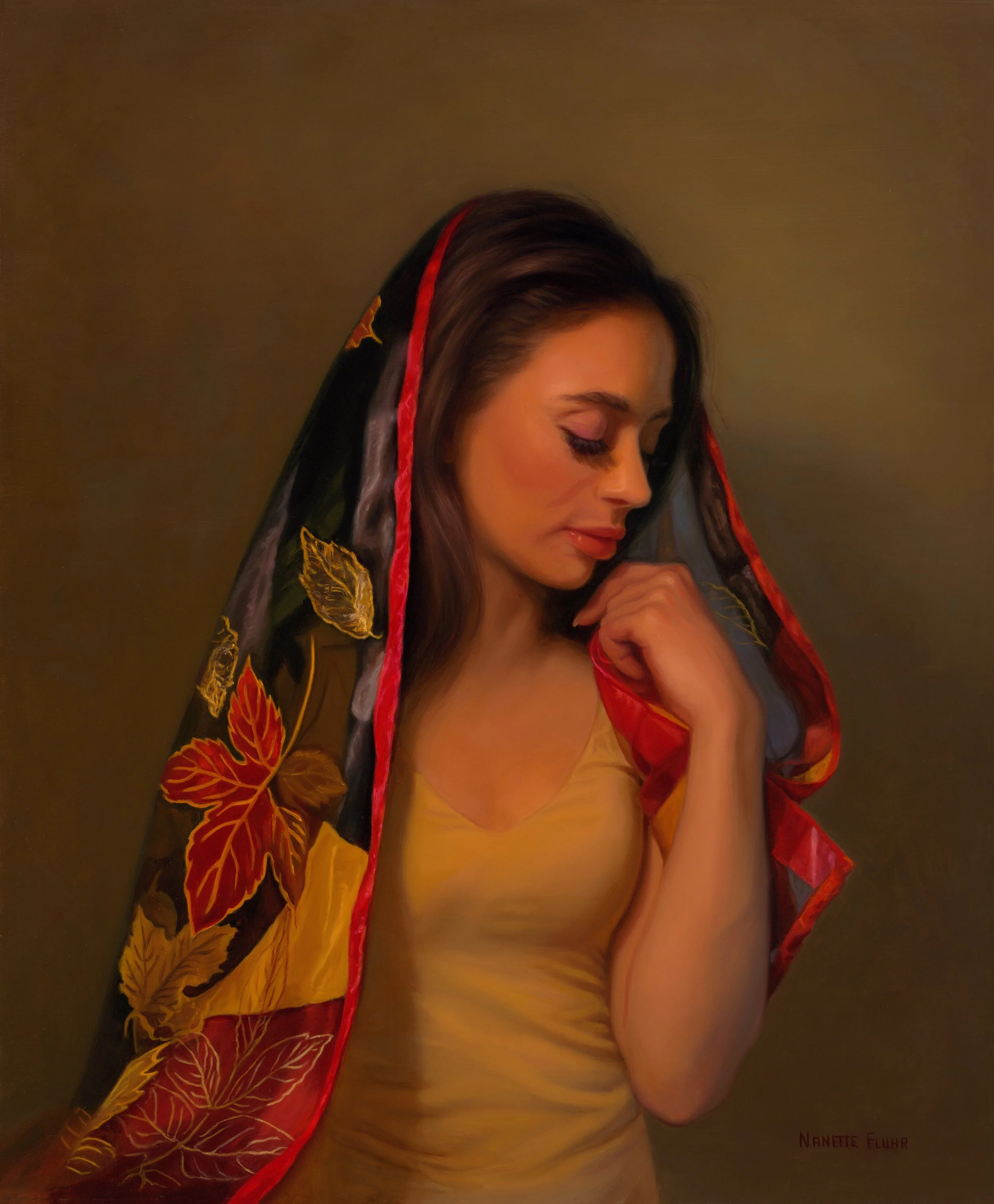
Autumn, 2022

Oil on masonite board

21 4/5 × 18 in | 55.4 × 45.7 cm

Frame included

In Autumn, Nanette Fluhr stages a lush threshold. The medium—oil on masonite—supports a saturation of color that feels less applied than emanated. The tones gather in a kind of dusk-light, warm and interior, as if illumination were arising from within the surface rather than falling upon it.

The drapery over the figure’s head offers a quiet allegory. Its autumnal leaves, in deep reds, ochres, and golds, unfold against a ground of black. Yet this black does not register as darkness in any oppressive sense. It does not foreclose the image. Instead, it deepens it. The leaves do not fall into shadow; they seem to be carried by it, held within it.

The woman’s posture—head inclined, eyes closed—withdraws from outward address. She is not presented for the viewer, but turned inward, as if receiving something. The gesture is contemplative, performative as such. While the figure is beautiful, the painting resists eroticization. Beauty here is not offered but absorbed. The viewer joins sympathetically in a gesture of spiritual inwardness.

Light as always is of the essence. The background glows softly, without a defined source, allowing the figure to emerge gradually rather than sharply. This diffusion creates a gentle oscillation of attention: the eye settles on the figure, drifts outward, then returns. The space feels less like a setting than a field of presence.

What the painting ultimately proposes is a reversal. Autumn, conventionally aligned with decline or loss, becomes here a moment of arrival. Not an approach to desolation, but an entry into fullness. The season does not empty; it gathers. The figure appears not at the edge of disappearance, but within a completed state—an immanence that is neither anticipatory nor retrospective. This is gesture in the moment, suspended as the moment's endurance.

Nanette Fluhr

Ascending, 2023

Oil on canvas

52 × 33 in | 132.1 × 83.8 cm

In Ascending, Nanette Fluhr presents a woman suspended in water, reaching upward in a state of quiet composure. The signs of submersion are delicately rendered: the drift of her clothing, the particulate shimmer of light, small bubbles gathering near her feet, the green-blue atmosphere, the steady presence of water lilies. Near the top, the surface flickers—light fractures into a trembling plane of reflection. Her hair billows gently. She is dressed in white, but the garment is unbinding rather than restrictive. The figure is not sexualized; the gaze is not directed that way. Instead, the painting situates us within a field of experience.

The realism is persuasive. The painterly handling of fabric, light, and suspension activates bodily memory—you feel the slowed physics of water, its resistance, its hush. The cues are subtle but cumulative. The viewer is drawn into an environment that is immersive without being overstated, tender without becoming indulgent.

Yet the painting never relinquishes its identity as paint. Particularly at the upper threshold, the surface breaks into more gestural, abstract strokes. The illusion thins. What reads as the surface of the water is also the surface of the canvas asserting itself. The eye shifts—from depiction into material. Paint incarnates into form, yet remains irreducibly paint.

This produces a structural divide within the image. Below: suspension, interiority, a dreamlike calm—almost pre-verbal, even womb-like. Above: flicker, disturbance, a threshold—of emergence, or perhaps of perception itself.

Her upward reach can be read as ascension, but also as contact with a limit. She reaches not only toward light, but toward the point where representation begins to fail—where the image discloses its making. This limit is staged within the painting. It implies a beyond, unbounded, luminous, yet the painting itself is bounded, held within its frame. The work thus enacts a recursion: a limit that contains its own beyond. In this sense, it becomes a metaphor for freedom within materiality.

The body is not eroticized. This absence is not neutral; it reorients the figure. She is not an object of vision but a subject of experience. Desire is not eliminated but transformed: it reappears as the desire to float, to rise, to release. The loose white garment reinforces this condition. What we witness is not a body posed, but a being passing through a state. The calm is not passivity so much as consent—an openness to transformation. Consent to something freeing not subduing.

The painting operates across three interwoven registers: narrative image (a woman ascending through water), embodied sensation (buoyancy, quiet, suspension), and material awareness (paint as paint, surface as surface). These layers do not resolve into unity but remain in productive tension. That tension resists sentimentality. It reminds us that the image is constructed, mediated, made.

The ascension, then, is not only hers. It belongs equally to the painting itself: a movement between illusion and its own facture, its facticity—those moments where the surface curls back into gesture, where paint declares its presence within the very scene it sustains.


Nanette Fluhr is an internationally recognized portrait artist whose work bridges classical technique with contemporary realism. Her work has been exhibited internationally, including at the European Museum of Modern Art in Barcelona and in a six-museum tour across China. Her portraits hang in courthouses and institutions nationwide, and her painting has been sold at Sotheby's.

After graduating from Rutgers University, she earned her BFA with honors from the School of Visual Arts, where she trained under John Frederick Murray, and later at his atelier. She served as a registered copyist at the Metropolitan Museum of Art, creating master copies of works by Rembrandt, Rubens, Van Dyck, Velázquez, Lawrence, and Vigée Le Brun.

She is the recipient of the Distinguished Achievement Award for Portraiture from American Women Artists and the HerStory Award from Manhattan Arts International. Her work is permanently archived in the Lunar Codex aboard NASA-partnered missions to the moon, making her among the first women artists to have work preserved beyond Earth.

Erica Calardo


Erica Calardo is a figurative painter living and working in Italy. Her works in oils, watercolors, and pencils are windows on the solitude of lost souls. She explores the realm of Beauty, Grotesque, and Magic, by creating eery oneiric feminine figures who tell tales of long forgotten dreams, of an imaginary timeless past.

Deeply rooted in the Italian Tradition, her technique is inspired by the Renaissance and Mannerism old masters (Leonardo, Bronzino, and Lavinia Fontana above all). She is mostly self-taught and has learned her skills from old dusty books. She has recently studied academic painting with Italian master Roberto Ferri.

Since 2010, she has showcased her work in galleries in Italy (Mondo Bizzarro, Studio21), and abroad (La Luz de Jesus - LA, Auguste Clown - Australia, Modern Eden, Swoon, Flower Pepper, WWA, and Spoke Art, Distinction - USA, Pinkzeppelin - Berlin among others). Erica's paintings have appeared in several magazines and books, like Miroir Magazine, Beautiful Bizarre, Il Manifesto, Inside Art, Italian Pop Surrealism, Illustrati.

ADD TO YOUR ART COLLECTION @ARTSY

Alexandra Telgmann | 2022 Year in Review

Was 2022 a good year for you?

It was an awesome year

What were some of the highlights in your art career?

Exhibition at the Meam Museum, Semi Finalist in ARC 16 Salon, huge article in the weekend journal in the local newspaper, finalist in the member only competition of the Portrait Society of America

What were some of the pitfalls?

Working very hard and now I´m a bit exhausted. 

Did you art sell?

Yes I´m pretty happy with all my sales and I have a lot new art collectors. 

Were you included in any shows?

MEAM show and upcoming show with gallery Artelibre and the Pictor gallery in New York.

Were you published in any art magazines or periodicals?

Yes in our cross regional newspaper in the cover page of the weekend journal.

How has  social media affected your daily practice?

Since reels are the new thing, I tried to film a lot more this year than taking photos and I still have additional material to cut. Also, I created an artist statement video.  

What are you looking forward to in 2023?

The show at the Pictor gallery, to start more great paintings, creating NFTs, to sell prints, submitting to magazines, being the best version of myself and getting better every day

Alexandra’s work specializes in the natural interaction between the female body and the element of water. The deep connection between the artist and the sea is visible in many of Alexandra's paintings. For her, the sea is a decelerating place of power that creates inner peace and at the same time reflects states of consciousness of one's own life. This intention always flows into her work.

The beginnings of Alexandra Telgmann's artistic work were influenced in her childhood by her father, an important goldsmith artist. After successfully completing her master's degree in goldsmithing, she studied portrait and nude painting at the College of Art and Design in Savannah/ USA and gave her artistic career a new direction. Numerous international and national exhibitions in Charleston (South Carolina), Las Vegas, Colorado Springs, Paris, Munich and Leipzig followed her first solo exhibition “Laconella” at the Pinnacle Gallery/Savannah USA. Her oil paintings are currently represented by the Grand Bohemian Gallery in Charleston /USA and the 33rd Contemporary Art Gallery in Chicago.

Q&A with Hyperrealist Matthew Quick

A conceptual surrealist, I combine technical virtuosity, an inquiring mind and a love of storytelling, to make quirky, often humorous, observations on the world around us.
— MATTHEW QUICK

Featured in BRW as one of Australia’s top 50 artists, Matthew Quick began painting as a teenager before being one of the youngest students to study art at the University of South Australia. Upon graduation Quick joined Emery Studio in Melbourne, designing for major corporations such as Rio Tinto, Fosters and BHP.

After a prosperous career in design and advertising and having written a number of fiction books, Quick returned to painting in his mid 30’s. In the past few years he’s won, or been a finalist for, 70 national juried art awards. He’s had 14 solo and more than 80 group shows. His work is included in the permanent collection of Australia’s most significant museum.

CURRENT SERIES

Matthew Quick’s exquisitely created paintings turn a mirror on our contemporary online existence in his latest body of work The Mirror Electric. The artist’s visual commentary drives to the heart of the imagery that populates our social media feeds.  Ricocheting from the amusing to the vacuous and absurd, his reading of the new visual shorthand of the online world is as sharp as ever. The mirrored surfaces and the ensuing interplay of one’s own reflection and the rendered surface of the painter’s hand is an immersive experience.

Q&A

What is your ultimate goal for your artwork?

All of the paintings are intended to engage the viewer with a narrative that operates on a number of levels.

At its most basic, it is intended to be intriguing, engaging and, hopefully, beautiful. However, it the viewer chooses to look a little deeper, layers of additional stories are revealed. Upon the combination of title and image, deeper meanings emerge, triggering the opening chapters to an endless array of stories the viewer is invited to create.

What concept or narrative is behind your work

The goal is pursue conceptual ideas that reveal societal issues and contemporary thinking. 

This is achieved by subverting symbols images of power with irony and humour. Statues and monuments were my starting point, as they frequently map the rise and fall of Empires with overt symbolism, providing the foundation for a revisionist take on the notions of beauty, pride, and nationalism.

By replacing their crowns and thrones with ordinary objects, the aura of emperors and gods are demoting to powerless nobodies. Through ridicule, I play with their initial grandiose goals, querying their motivations and questioning the orthodoxy of accepted history.  In doing so, I reference themes such individual freedom, social control, surveillance, and the deceit of rulers who intentionally fail to act as they speak.