Moments of Gesture | Nanette Fluhr
Notes on Nanette Fluhr by John Hughes
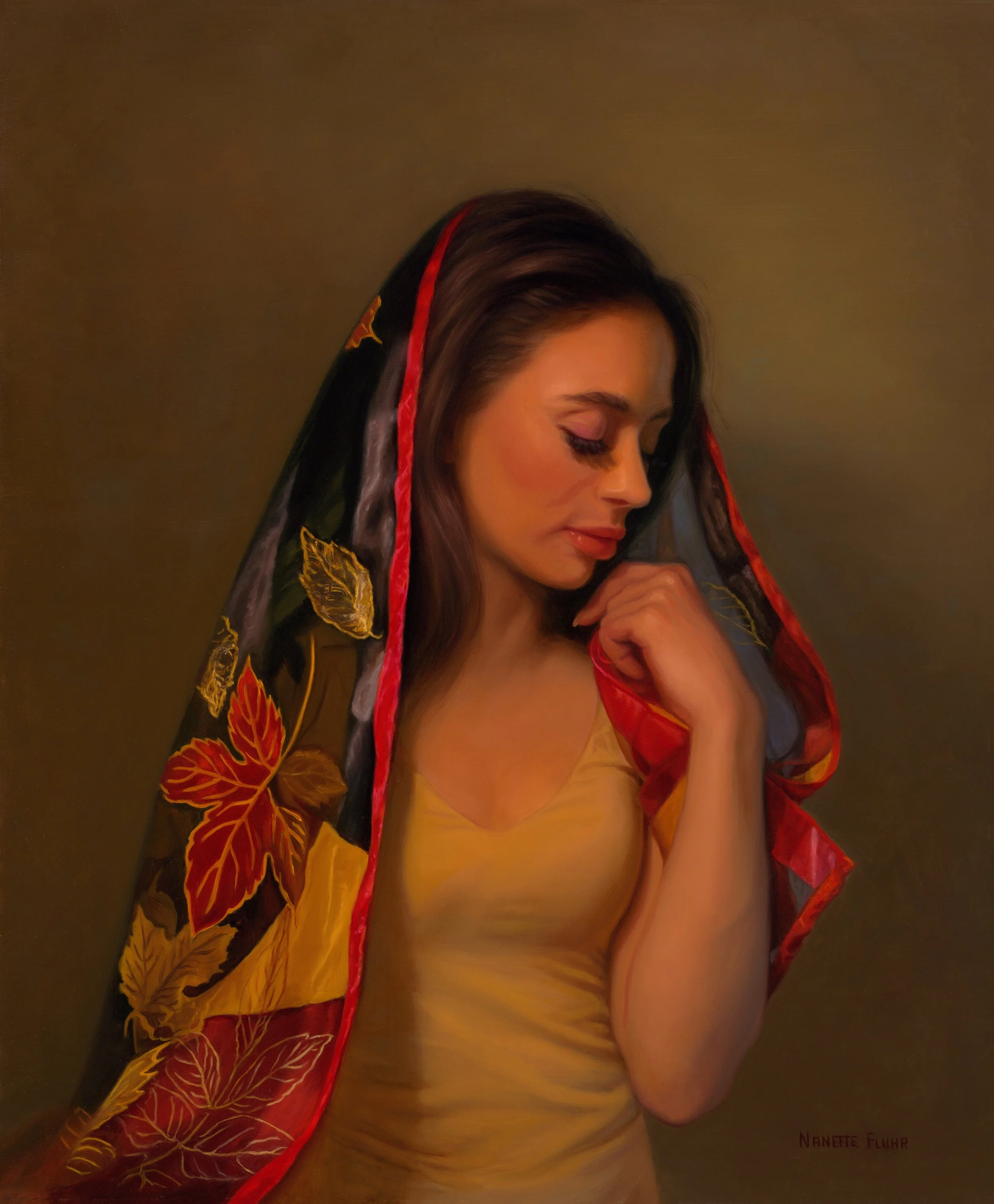
In Autumn, Nanette Fluhr stages a lush threshold. The medium—oil on masonite—supports a saturation of color that feels less applied than emanated. The tones gather in a kind of dusk-light, warm and interior, as if illumination were arising from within the surface rather than falling upon it.
The drapery over the figure’s head offers a quiet allegory. Its autumnal leaves, in deep reds, ochres, and golds, unfold against a ground of black. Yet this black does not register as darkness in any oppressive sense. It does not foreclose the image. Instead, it deepens it. The leaves do not fall into shadow; they seem to be carried by it, held within it.
The woman’s posture—head inclined, eyes closed—withdraws from outward address. She is not presented for the viewer, but turned inward, as if receiving something. The gesture is contemplative, performative as such. While the figure is beautiful, the painting resists eroticization. Beauty here is not offered but absorbed. The viewer joins sympathetically in a gesture of spiritual inwardness.
Light as always is of the essence. The background glows softly, without a defined source, allowing the figure to emerge gradually rather than sharply. This diffusion creates a gentle oscillation of attention: the eye settles on the figure, drifts outward, then returns. The space feels less like a setting than a field of presence.
What the painting ultimately proposes is a reversal. Autumn, conventionally aligned with decline or loss, becomes here a moment of arrival. Not an approach to desolation, but an entry into fullness. The season does not empty; it gathers. The figure appears not at the edge of disappearance, but within a completed state—an immanence that is neither anticipatory nor retrospective. This is gesture in the moment, suspended as the moment's endurance.
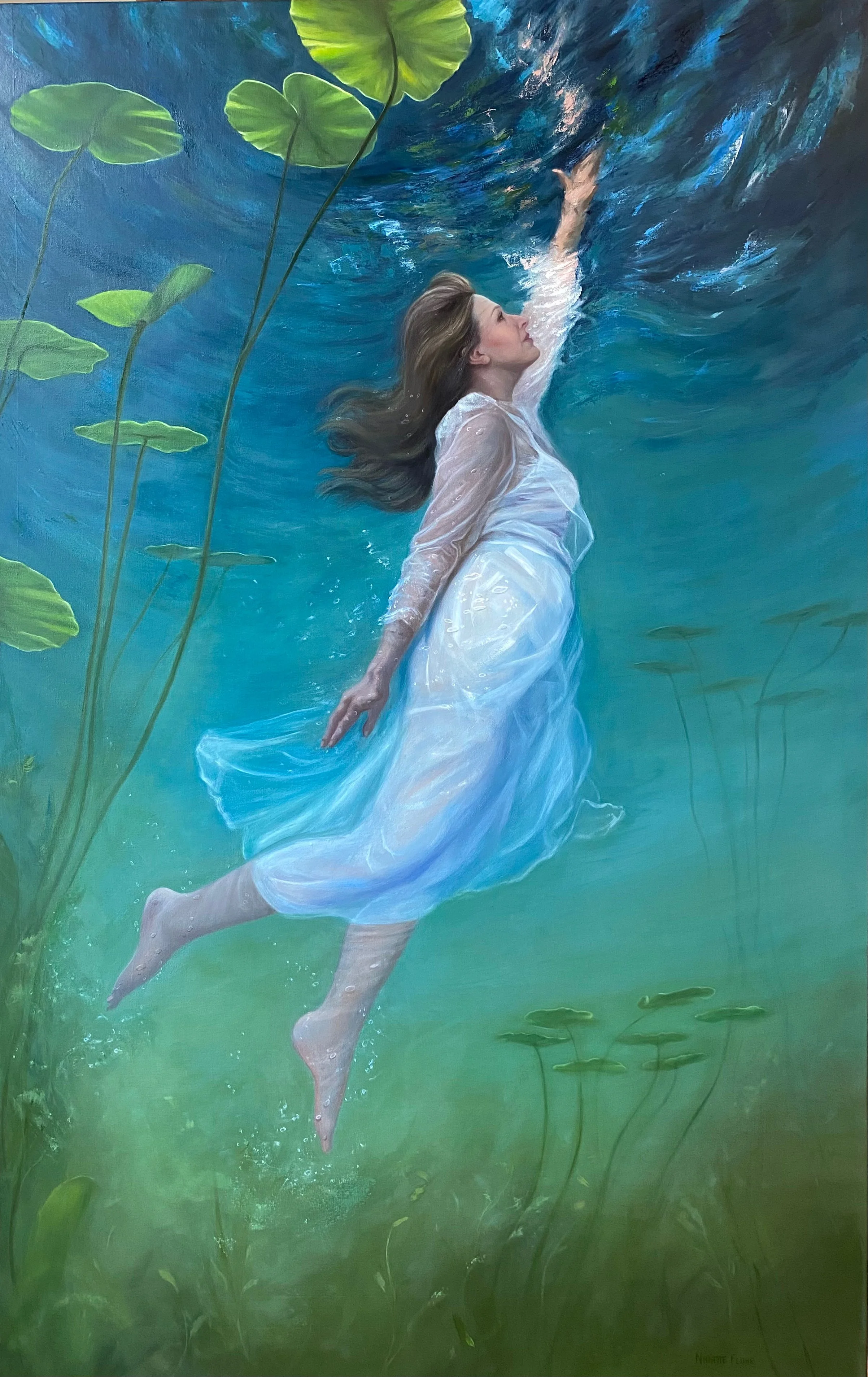
In Ascending, Nanette Fluhr presents a woman suspended in water, reaching upward in a state of quiet composure. The signs of submersion are delicately rendered: the drift of her clothing, the particulate shimmer of light, small bubbles gathering near her feet, the green-blue atmosphere, the steady presence of water lilies. Near the top, the surface flickers—light fractures into a trembling plane of reflection. Her hair billows gently. She is dressed in white, but the garment is unbinding rather than restrictive. The figure is not sexualized; the gaze is not directed that way. Instead, the painting situates us within a field of experience.
The realism is persuasive. The painterly handling of fabric, light, and suspension activates bodily memory—you feel the slowed physics of water, its resistance, its hush. The cues are subtle but cumulative. The viewer is drawn into an environment that is immersive without being overstated, tender without becoming indulgent.
Yet the painting never relinquishes its identity as paint. Particularly at the upper threshold, the surface breaks into more gestural, abstract strokes. The illusion thins. What reads as the surface of the water is also the surface of the canvas asserting itself. The eye shifts—from depiction into material. Paint incarnates into form, yet remains irreducibly paint.
This produces a structural divide within the image. Below: suspension, interiority, a dreamlike calm—almost pre-verbal, even womb-like. Above: flicker, disturbance, a threshold—of emergence, or perhaps of perception itself.
Her upward reach can be read as ascension, but also as contact with a limit. She reaches not only toward light, but toward the point where representation begins to fail—where the image discloses its making. This limit is staged within the painting. It implies a beyond, unbounded, luminous, yet the painting itself is bounded, held within its frame. The work thus enacts a recursion: a limit that contains its own beyond. In this sense, it becomes a metaphor for freedom within materiality.
The body is not eroticized. This absence is not neutral; it reorients the figure. She is not an object of vision but a subject of experience. Desire is not eliminated but transformed: it reappears as the desire to float, to rise, to release. The loose white garment reinforces this condition. What we witness is not a body posed, but a being passing through a state. The calm is not passivity so much as consent—an openness to transformation. Consent to something freeing not subduing.
The painting operates across three interwoven registers: narrative image (a woman ascending through water), embodied sensation (buoyancy, quiet, suspension), and material awareness (paint as paint, surface as surface). These layers do not resolve into unity but remain in productive tension. That tension resists sentimentality. It reminds us that the image is constructed, mediated, made.
The ascension, then, is not only hers. It belongs equally to the painting itself: a movement between illusion and its own facture, its facticity—those moments where the surface curls back into gesture, where paint declares its presence within the very scene it sustains.
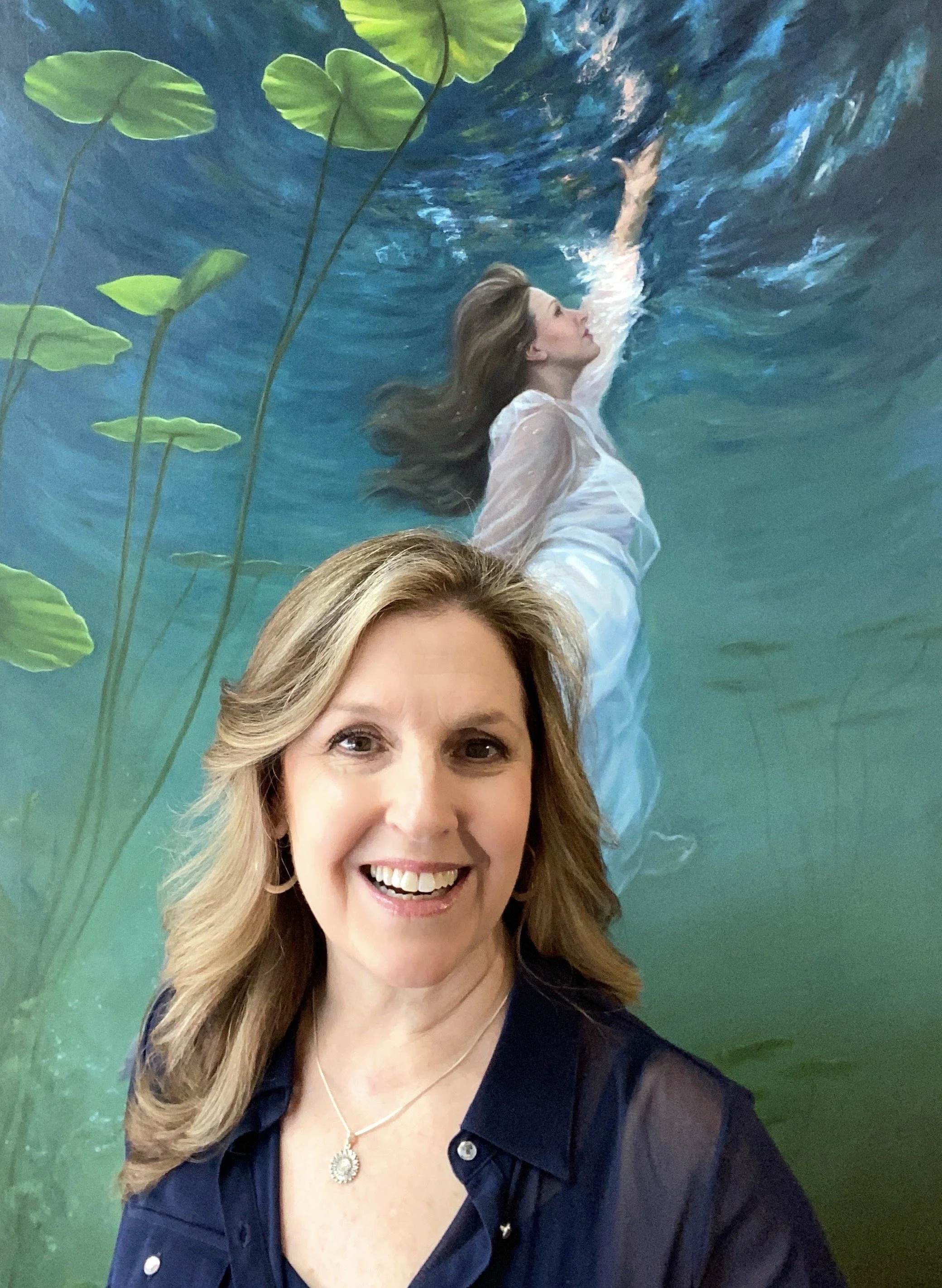
Nanette Fluhr is an internationally recognized portrait artist whose work bridges classical technique with contemporary realism. Her work has been exhibited internationally, including at the European Museum of Modern Art in Barcelona and in a six-museum tour across China. Her portraits hang in courthouses and institutions nationwide, and her painting has been sold at Sotheby's.
After graduating from Rutgers University, she earned her BFA with honors from the School of Visual Arts, where she trained under John Frederick Murray, and later at his atelier. She served as a registered copyist at the Metropolitan Museum of Art, creating master copies of works by Rembrandt, Rubens, Van Dyck, Velázquez, Lawrence, and Vigée Le Brun.
She is the recipient of the Distinguished Achievement Award for Portraiture from American Women Artists and the HerStory Award from Manhattan Arts International. Her work is permanently archived in the Lunar Codex aboard NASA-partnered missions to the moon, making her among the first women artists to have work preserved beyond Earth.