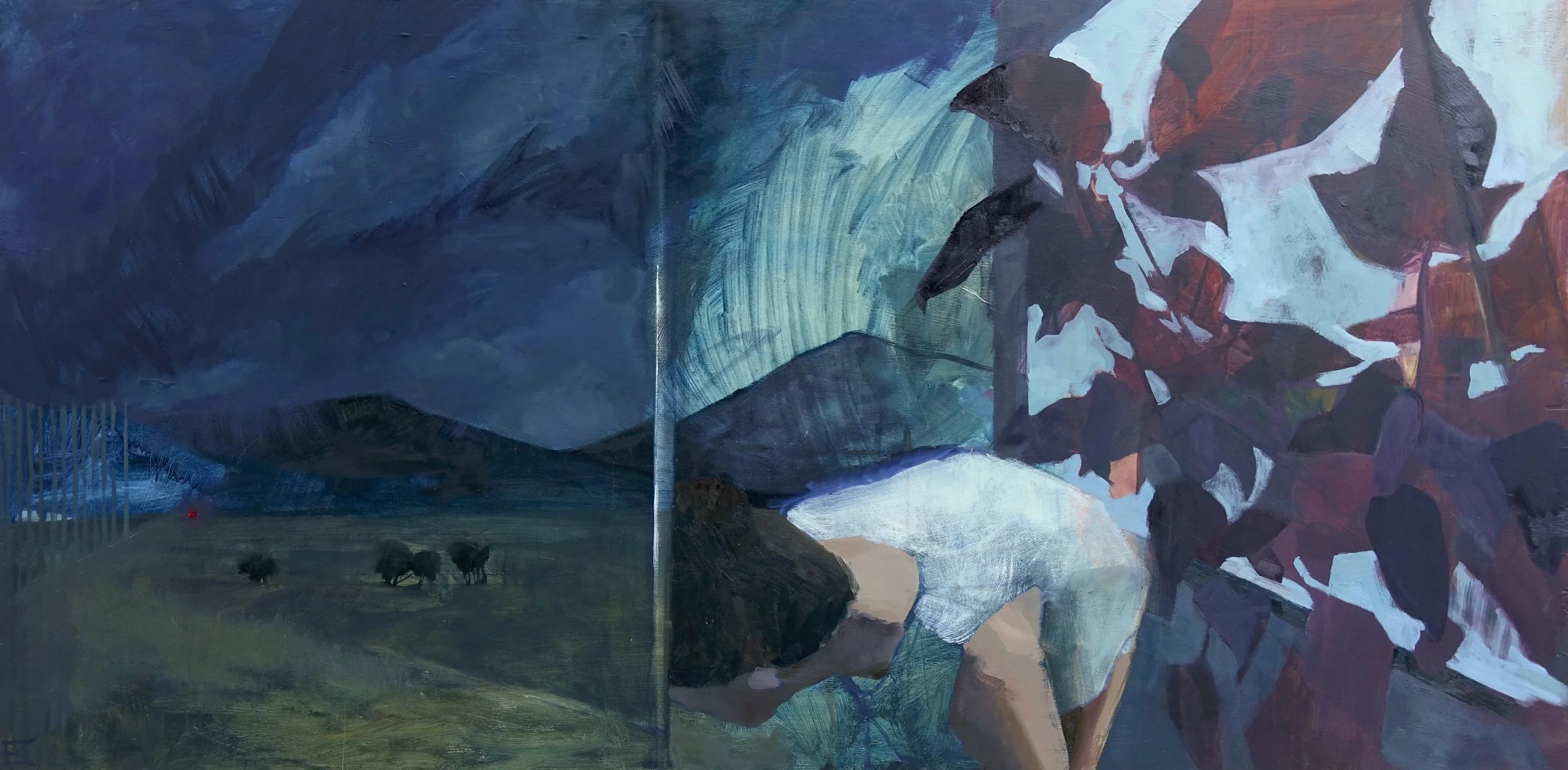
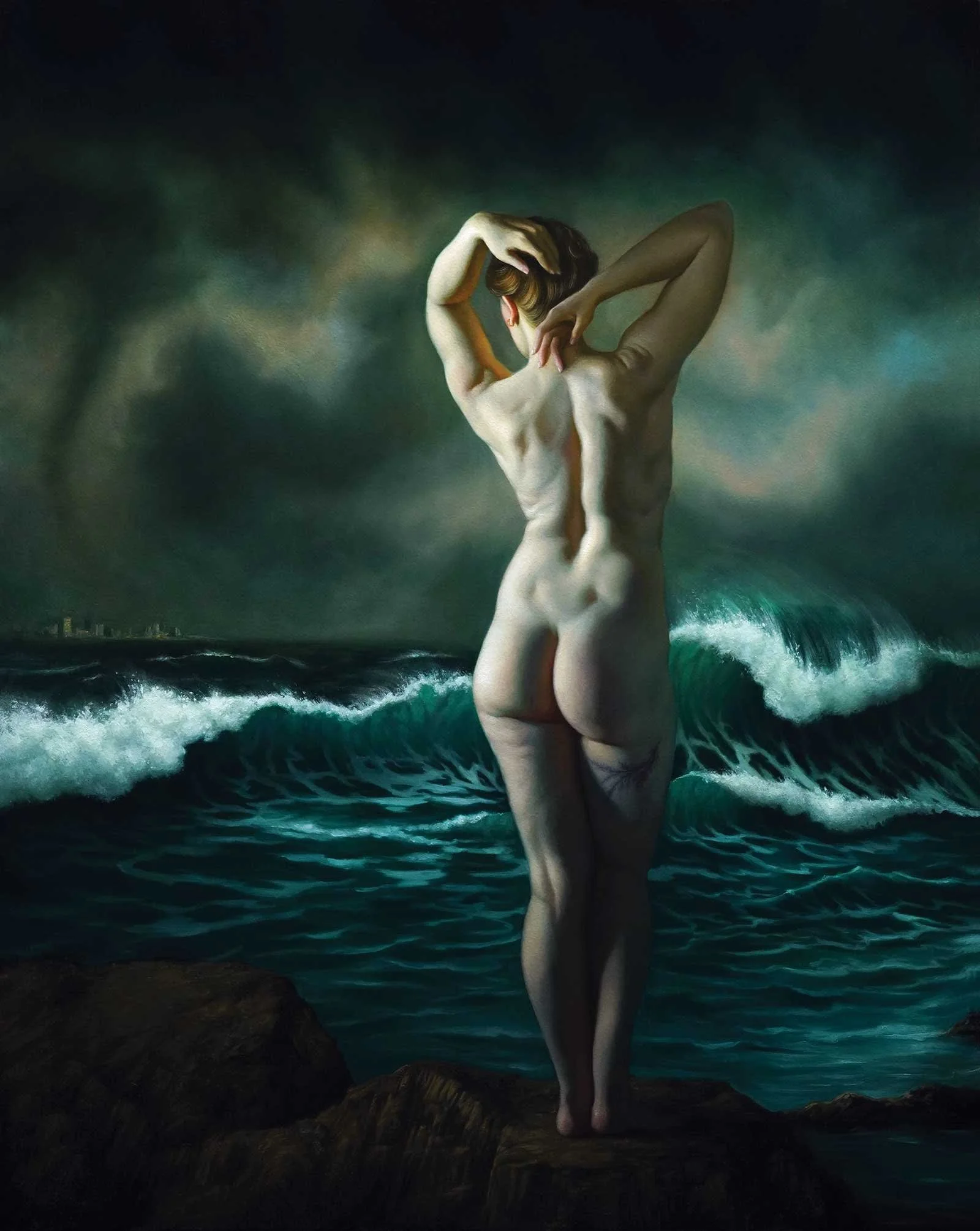
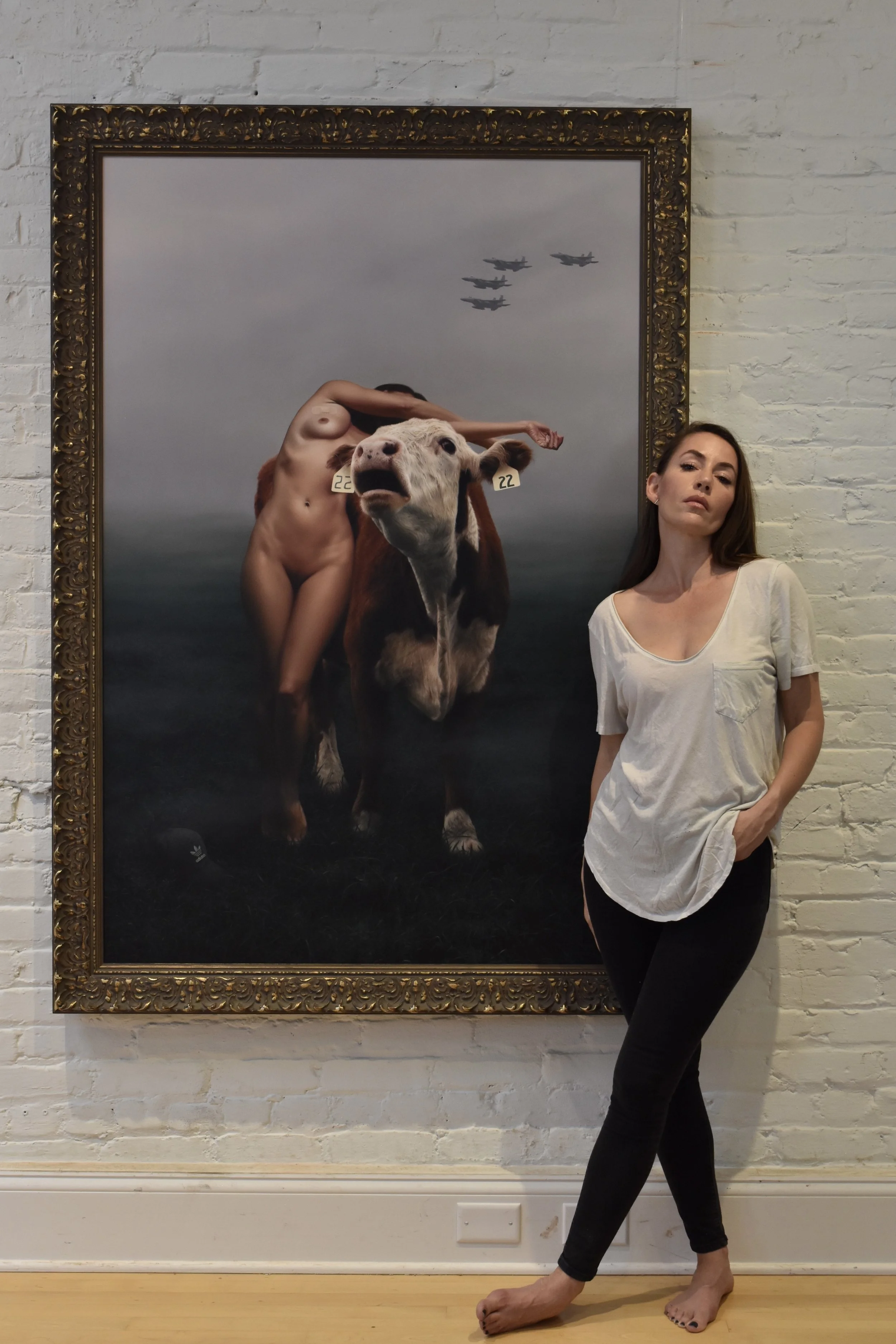
Is it a Photograph? Curated by Jan Anders Nelson

I surveyed this group with the question, “What is the relationship of a photograph to your work?”

The artists represented in this exhibit all use photographs in the creation of their works.  None of them see duplication of a photo as a goal, but as a starting point, a sketch, a reference, a layout tool, a moment in time, a part of a storyboard etc., though the relationship between artist and photograph is unique in each case.

Any artist who works in a technically tight discipline is capable of creating imagery that can be mistaken at a glance for photographs.  When a viewer comments “Wow! That looks like a photo to me!” the intent is usually a positive one, complimenting the artist on their technical skills. Several of the artists here expressed that they are happy to accept that enthusiasm as a compliment, and hope that the initial engagement leads to a deeper connection to the viewer’s relationship with the work, at times reaching an awareness of the intent of the artist or of feeling a personal connection to the art.

I could delve into the use of photography as a tool by artists, the long history of layout aids, and about whether use of a camera is cheating or lazy and the increasing role of photo manipulation tools like Photoshop as a key part of an artist’s process.  I could talk about the rise of AI in making artworks, leveraging the millions of images that live on the Internet and keying in phrases to compose works.  But these are topics that others have covered in great depth, or in the case of AI created art, a topic of emerging interest needing more time to evaluate.  I am leaving all that to others, my intent with this exhibit is focused on how these seven artists view their relationships with photography, and value their own processes.  And, in the end, I will comment a bit about my own relationship with photographs in my work.

Jan Anders Nelson

October 14, 2022

Gig Harbor, Washington


ELIZABETH BARDEN

Elizabeth Barden

Jaya-ism, 2019

Oil on linen

14 × 11 in | 35.6 × 27.9 cm

Elizabeth Barden is an Australian artist focused firmly on figurative art and the narrative. In her words, “Through my paintings I can tell visual stories of people, to highlight uniqueness and strengths as we seek ways to understand ourselves, and our communities.”

“I am attracted to the strength of personality I see in Elizabeth’s portraits, they transcend technical transcription of the topography of faces and moments.

JAYAJa-yah/ proper noun–derived from Sanskrit, meaning Victory. ISMizm–noun-a distinctive practice system, or philosophy, typically a political ideology oran artistic movement.

Jaya Suartika is an Adelaide based artist. My subject’s skin is almost entirely covered in tattoos, only his face is devoid of ink. Jaya says initially he chose to get tattoos because of the punk side of it, anti-establishment. He was in the punk scene and it was a kind of ‘fuck you’ to the norm. His attitude has changed now, and his inked skin has evolved into aesthetic recognition and personalized ornaments.

If I have to wear a label, it is 'Contemporary Figurative Artist', and my work inhabits the genre of Realism. I regard myself as a storyteller.

I am an Australian artist, living in the beautiful Cairns, Far North Queensland.
I’m often painting people who live far away. Although I always travel to have live sittings, it essential for me to take photos as on-going reference to use in my studio.
If another artist had the opportunity to paint from my reference photos, I can absolutely assert that their result would be greatly different to mine. I do not rely upon a single image, and each artist brings their own vision to their work. My reference photos also play a vital role in permitting me to intimately examine certain elements, without compromising my comfort or that of my sitter. Portraying another human is a somewhat voyeuristic undertaking, and that is accompanied by a trust and responsibility.

I am not a hyperrealist. In representing my subject, I curate the human qualities that I wish to bring to the fore, and I employ various art and design principles accordingly. I hope when I paint someone I can inject a feeling that goes beyond skill or technique, beyond outward appearance to what lies within. I seek to learn from observation, to represent in visual simplicity an emotional complexity - a hint of the inner self in a sincere and sensitive portrayal. I seek to celebrate identity.

There are viewers who believe they are awarding you a supreme compliment by saying ‘it looks just like a photograph’. I understand they are taking the time to express an appreciation, perhaps focusing only on the skill, and I accept the honest sentiment.

My artist heart beats faster when a viewer grasps the deeper meanings and complex emotions hidden in plain sight, and they respond in a way that shows they understand, truly understand the subtleties. My work is never aspiring to mimic a photograph, my paintings are layers and layers of brushstrokes intentionally placed to build a sense of the time, place and person - their story and perhaps a little of mine.”


VICTOR GADINO

Victor Gadino

Taking Back The B Word, 2021

Oil on linen

30 × 24 in | 76.2 × 61 cm

Victor is a classically trained artist who holds an MFA from Pratt Institute. His work spans illustrations for movie posters, album covers, posters for Broadway plays.  It is this illustration background that pops for me in his painting “Taking Back the B Word”.  The message conveyed in this work is quite clear with the interplay of the graffiti and the subject of the title in an expression that seems to be telling the viewer to step back, that she is in charge of her life.  While it may not be politically charged by intent (I did not discuss this with Victor), the feeling it invokes in me is certainly aligned with contemporary events and how strong women are cast as bitches by men in power who fear losing their control.

“Like many artists who paint and draw realistically, I rely on photos as my main reference. But my goal is never for a painting or drawing to actually look like it’s a photograph. Unlike hyperrealists who render every hair or pore on a person’s face, I like the sense that the artist’s eye, hand and emotion played a part in the creation of the image. I’m not trying to trick the eye of someone into thinking they are looking at a photograph.

I learned years ago; when I was creating art for movie posters and using movie stills that the studios supplied; that what appears real in a photo isn’t necessarily correct or pleasing to look at. The artist's eye has to pick and choose elements that fit their aesthetic goal.

My process is this: I research an idea, scribble a sketch and make notes, find or hire a model and have a photoshoot, manipulate the photos in photoshop (a great deal) and create a digital image that matches the vision in my head. The finished image may look photographic but it doesn't exist except on my computer. That is what I then use as my reference . Then when I’m drawing or painting I allow brush strokes or pencil lines to be visible so that the trained eye knows it’s not photograph.”


MARIAH KAMINSKY

Mariah Kaminsky

Her Resolve, 2022

Oil on canvas

20 × 16 in | 50.8 × 40.6 cm

A graduate of Ball State University’s Design/Technical Theater program, Mariah’s work as a scenic artist at playhouses in Indiana and Maine developed her skill for artistic detail. This training is evident to me in the dramatic poses in her art, that speak to me of strong emotion in the artist about her subjects.  While she says she is focused on joy or simple pleasures in life, and her subjects reflections of “positivity, optimism and resilience; the themes that she finds the most urgency to highlight in today’s turbulent society”, in “Her Resolve” there is a more pensive moment depicted.  I asked Mariah about this work and its meaning for her.

“She represents a quiet resolve in myself... I was quite depressed & feeling very stuck when I began this series. The energy of this painting and the act of painting it did indeed help me out of my dark space.”

I asked Mariah, if a viewer comments "it looks like a photo!", are you satisfied with that level of engagement?

“Honestly, I would rather they say, "It looks so real!" But I think maybe most people believe they are one in the same.

I use photographs to capture the specific pose or expression that I am looking for in the model. I then use those images as reference for the painting. I design the painting entirely in Photoshop and then have that image on a screen beside the painting while I work. I do try to be as photorealistic as possible while keeping a "painted" quality to the final piece.”


GWEN MANFRIN

Gwen Manfrin

It was only when she Closed her Eyes, that she Could See the Stars, 2022

Graphite on paper

24 × 18 in | 61 × 45.7 cm

Graduating from the University of California, Los Angeles with a B.A. in Fine Art, Gwen has a focus on what she refers to as both sensory and metaphoric, saying “For me, the figure provokes an immediate response, a subliminal messaging through body language and attitude.”  It is her observation of people as they move through their lives that teases out these moments that reveal an inner sense.  In “It was only when she closed her eyes that she could see the stars” I found myself attracted to the possibility of a young person who needs to close out the external noise and pressures of her life in order to find her dreams.  It is a feeling that is familiar to me.

“I am inspired by emotion.  This particular piece gave me the opportunity to explore a very passive expression.  The security of her placing her hands on each cheek giving her comfort in the moment.  And even with closed eyes, I could feel a strong emotion. One that says, “ I am released to see so much in this moment, the forever starry skies, the peace of my heart, the serenity of my life. My gaze sees the stars and the endless possibilities of my dreams and wishes.”

The gentleness of her hair and satin dress , her quiet pose all make room for this quiet emotion.  I felt peace during the creation of this work and still do when I look at it.

I use photography in a few ways. I often shoot my own subjects, while in conversation with me.

This necessitates me getting to know my model so that I can recognize a true emotion.  (Thank goodness for digital!, I can take a lot of images).  Then i spend time with the images and the perfect expression/body language will become readily apparent. 

I did a selfie series, recently. I am not fond of selfies and was amazed when I saw a person spending, all by herself, taking what must have been 500 shots of herself,(and while standing in a beautiful environment). All that mattered to her was getting that perfect shots to post…..when I started digging into the internet, I would find 100 of pics of the same person.  So, it was like having a model to shoot, except my perception of this person was really the sitter’s own perception.  That was interesting and enlightening.

So now, I use a combination of the two.  I sometimes take my own images and I sometimes search for an image and try to find more of that same person , to help me understand their motivation.  The final artwork can be a combination of many images.

Since I am looking for a chance encounter, the use of photography helps me to capture that moment.  If the model were sitting for me to draw or paint, I would lose the spontaneity of a quickly glimpsed moment.”


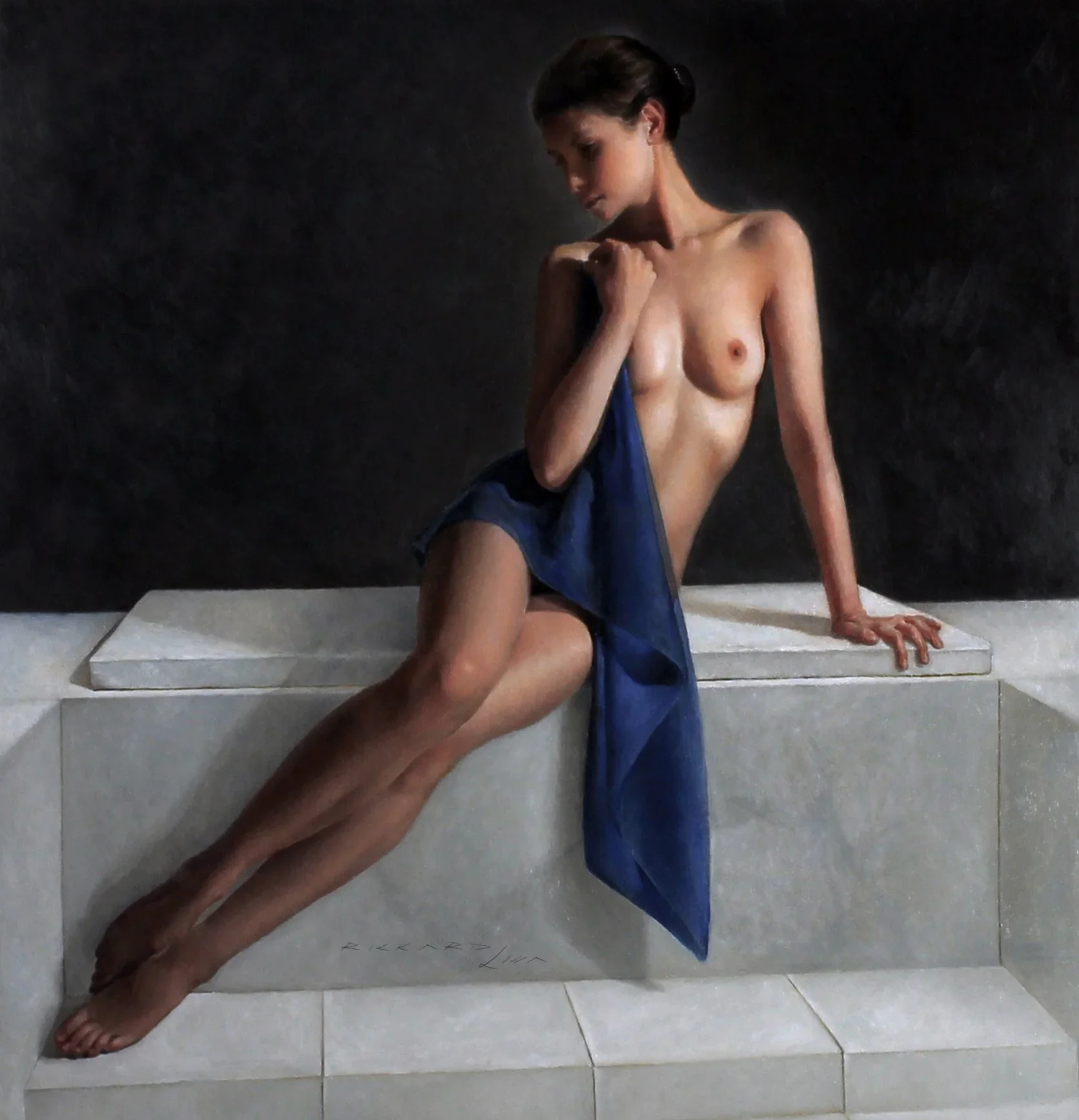
LISA RICKARD

Lisa Rickard

Callisto, 2019

Oil

14 × 14 in | 35.6 × 35.6 cm

Focused on the nude, Lisa is classically trained, earning her BFA in Graphic Design from the Milwaukee Institute of Art & Design and studied drawing and painting at Temple University Tyler School of Art.  Her time as a dancer and dance instructor has strengthened her insights into the power of the human form and feels like it guides her work creating what she refers to as a series of allegories in her paintings.  

In “Callisto”, I am attracted to her use of chiaroscuro to create a dramatic scene depicting an individual in quiet repose.  The lighting is quite striking as it reveals the subject, the composition reminiscent of thinking “mise-en-scène” from my days in theatre.

“Callisto is the second painting in a series of allegorical figures about three stages of life: youth, adolescence and adulthood. Callisto represents the adventurous adolescent reflecting the most fascinating moon with the same name. Callisto is the only one of Jupiter’s 79 moons that scientists believe may have an underground ocean. And if it does, Callisto may have a chance at supporting life.I am always thinking about finding and revealing on paper or canvas the beautiful stories hidden in the simple gestures made by the nude human form.

As a nude allegorical figure painter, I am inspired by the gestures of the nude human form for creating timeless and universal stories. Having been a dancer, dance teacher and drawn/painted from live nude artist models that were dancers, I am inspired by the beautiful design of the human body. I develop my ideas for paintings and now use photography as a tool to help me interpret the mental picture that I see in my imagination. The figure always represents an allegorical story in my paintings - something as simple as adolescence to more complicated stories such as the melding together of opposite states of mind. The photograph reminds me of how light flows over human form in real life. I think about the light flow while I’m painting with photographic reference material and how the hue, value and chroma of my paint swatches from my pre-mixed color strings on my palette will be applied to the linen surface to visually create a feeling of three dimensional form to ultimately illustrate an inspirational allegorical concept represented by the figure and any additional elements in my composition.”


DAGGI WALLACE

Born and raised in Berlin, Germany, currently living near Los Angeles, CA, Daggi is a self-taught painter specializing in contemporary figurative realism and portraiture.  I was initially attracted to Daggi’s use of pastel and charcoal as primary painting mediums, and thinking of the works as paintings.  My own work with these tools felt like drawings to me, the differences in attitude being an area to think about more.

I found the two paintings “Joshua” and “Pamela” from Daggi’s series “We All Bleed Red” to be important as a set, a diptych of expression that is just a part of the larger series of 16 portraits in the series.  Daggi invited me to look at her notes about each subject to check in with my own initial reactions to them and see where I landed compared to the stories of the individuals.  Putting my own perspectives and biases on the line is a powerful force to confront honestly.

“Joshua is a devoted single dad of a toddler son living in Wyoming. Most of his many tattoos are inspired by the world of Disney.

Born and raised in Sacramento, CA to Chinese immigrant parents, Pamela is a former runway and print model for clients ranging from Target to Tiffany and everywhere in between (IMagnin, Neiman Marcus, Saks Fifth Ave, Oscar De La Renta, Givenchy, Donna Karen, David Hayes, Giorgio Armani, Chanel to name a few.) She was also a TV and theater actress and after earning her Master of Fine Arts’ Degree from the Art Center College of Design in Pasadena Pamela is now an award winning contemporary painter blending Asian historical graphic subjects with abstract art.”

For me photography is a tool as well as inspiration to create my images. While I view drawing and painting from life as a necessary practice to hone my skills, practice is the main word there because I don't think I have ever framed and displayed a piece that was done from life. They simply don't meet my own standards of the detail and realism I like to achieve in my work. Photography gives me the gift of time and space: enough time to contemplate the poses, lighting and story I want to tell through them and enough space away from the model where I can focus completely on the painting process and not worry about the model's comfort level. By nature I'm an introvert even though I have learned to hide it well, an observer of people who has not found a way to interact with my subjects, talk to them, tune into their moods and form a connection with them while at the same time focusing on the actual act of drawing or painting.

I get nervous before a photo shoot, mainly because I worry about making my model feel comfortable in front of the camera (many are not professional models), something I struggle with myself. But usually once we get started the creative collaboration between us begins to flow and we have a blast. Also, I prefer capturing emotional moments in my work, sometimes intense and fleeting ones that are just not possible to capture during a live sitting.

After the shoot I am then able to take all the time I want perusing the resulting photos and choosing which ones will end up as paintings. I absolutely love going through hundreds of pictures, noticing which ones immediately give me that physical reaction, the goose bumps, the butterflies, the hair standing up. Those are the ones that get me excited to go into the studio and start planning the resulting paintings. Sometimes I go through photos again months or even years later and it's always interesting how my reaction may have changed by then. The ones that sparked an initial response may now leave me cold while others may move to the forefront of possible new work and could even result in new ideas that were not part of the original photo session. 

Most importantly, having the solitude and time to view all of the photos for as long as I want creates space in my mind to listen to the muse's direction, how I want to interpret a given photo, what things I might add to it or leave off, what color scheme I want to employ. Often, titles present themselves very quickly, too, but none of this works for me if I'm still in the room with the model worrying about whether they are hot or cold, bored or tired, feeling like I have to make conversation which would then make it impossible for me to hear that inner voice of intuition.

The quiet detachment that photography affords me is vital to my working process of connecting to my thoughts and intentions without any outside distractions. Often, the photo shoot and subsequent viewing and planning take much longer than the actual painting process!

Once I have tuned into my ideas and plans I can then take my time executing them to the best of my ability no matter how long it may take. The technical aspects are made easier because the light remains constant, I can zoom in on details, change things such as composition, background, texture, even color and contrast to some extent, all without needing another sitting with the model. I can even play around with using the same reference pics with a variety of styles, techniques and materials resulting in very different images. This is vital for my artistic growth as I enjoy experimenting marrying realism with abstract components. Photography as reference is the best tool for me and my personality to achieve my objectives.

On another very different note, working from photographs also allows me to work with commission clients or models who are not in my area or are no longer living (I have done quite a few commissioned posthumous portraits). While I find this difficult and prefer taking the reference photos myself so I can meet the person and get a better understanding of their personality, body language and coloring it is nonetheless a useful tool that allows for more options.”


DOUG WEBB

Doug Webb

Moving On, 2021

Acrylic on linen

20 × 16 in | 50.8 × 40.6 cm

Doug, who considers himself a “classic, romantic surrealist” emigrated from Istanbul, Turkey at a young age, to California.  Self-taught, Doug has a special relationship with the work of Rene Magritte and references that interest frequently in his subject matter through the use of what he refers to as “the recognition of opposites” and of contradictory scale of elements placed in the same composition.  I find his works to be fun and introspective with strong feelings of satire and irony as well as political or cultural commentary, at times about the duality of the pursuit of happiness while living in the rat race of conformity.  When I first encountered one of Doug’s works in person, I was a bit confounded by the excellent craftmanship of his art, the work being virtually inscrutable in process and asked him about how he achieves the extreme realism of the subject matter, a bit of irony in itself when looking at the surreal compositions he creates.  His work is in acrylic, composed of many layers of glazing over an underpainting.  And, while it is easy to be captivated by that technical skill, I am drawn to the metaphors he creates, such as the story he tells in “Moving On” of a boy growing up and leaving youth behind.  There is a familiar emotion for me in the imagery that rings true.

“This painting depicts a young boy saying goodbye to his faithful companion/Teddy Bear, as he begins his transition towards adulthood. It was inspired by New Testament Bible scripture, 1 Corinthians 13:11, which reads “When I was a child, I thought like a child, I reasoned like a child. When I became a man, I put the ways of childhood behind me”.

The photographic reference is vital to drawing the viewer in. It gives me all of the obsessive details I need to capture your attention and then hopefully the viewer will be touched by the message. The photo is the launching pad but not the destination. That’s when the surreal kicks in.


JAN ANDERS NELSON

Jan Anders Nelson | Kodachrome | 35cmx35cm, oil on canvas 2020 | Permanent collection of the Coupelouzos Family Art Museum in Athens

In “Kodachrome”, done in 2020, I took an introspective leap back in time to the mid-70s when I was almost exclusively using slide film.  The image is of the ubiquitous Kodachrome film packaging, a piece of litter I found next to my parking space around 1975, the irony of using that same film to record the moment not lost of me then or now.  While slide film is a thing of the past, and “Kodachrome” mostly remembered as a classic rock song, the exploration of the image grew out of my finally digitizing a fairly large collection of my slides I had been carrying around for decades.  That act forced me to look at them and started an internal dialog with that young artist from the 70s as if going back in a time machine.

I’ve always used my camera as my field notebook, a quick way to capture a moment in my life.  As I turned toward studio art from working in the theatre, those photographs became references both of time and place and compositional aides as I created my layouts.  Initially, I worked freehand, but found that use of a grid I created from a clear piece of acrylic gave me greater ability to focus on small areas within the reference.  The next step was to use an overhead projector as a method to quickly layout onto paper or canvas.  That led me to use of a slide projector (the subject of “Kodachrome”) and today a video projector.  The photographs themselves required work in the darkroom to get exposures dialed in, replaced today by Photoshop where I find myself guilty of “pixel peaking” when digging for deeper understanding of specific aspects of the work I am creating, using some of the features to adjust the image somewhat to express the memory of that moment from my perspective.

Q&A with Hyperrealist Matthew Quick

A conceptual surrealist, I combine technical virtuosity, an inquiring mind and a love of storytelling, to make quirky, often humorous, observations on the world around us.
— MATTHEW QUICK

Featured in BRW as one of Australia’s top 50 artists, Matthew Quick began painting as a teenager before being one of the youngest students to study art at the University of South Australia. Upon graduation Quick joined Emery Studio in Melbourne, designing for major corporations such as Rio Tinto, Fosters and BHP.

After a prosperous career in design and advertising and having written a number of fiction books, Quick returned to painting in his mid 30’s. In the past few years he’s won, or been a finalist for, 70 national juried art awards. He’s had 14 solo and more than 80 group shows. His work is included in the permanent collection of Australia’s most significant museum.

CURRENT SERIES

Matthew Quick’s exquisitely created paintings turn a mirror on our contemporary online existence in his latest body of work The Mirror Electric. The artist’s visual commentary drives to the heart of the imagery that populates our social media feeds.  Ricocheting from the amusing to the vacuous and absurd, his reading of the new visual shorthand of the online world is as sharp as ever. The mirrored surfaces and the ensuing interplay of one’s own reflection and the rendered surface of the painter’s hand is an immersive experience.

Q&A

What is your ultimate goal for your artwork?

All of the paintings are intended to engage the viewer with a narrative that operates on a number of levels.

At its most basic, it is intended to be intriguing, engaging and, hopefully, beautiful. However, it the viewer chooses to look a little deeper, layers of additional stories are revealed. Upon the combination of title and image, deeper meanings emerge, triggering the opening chapters to an endless array of stories the viewer is invited to create.

What concept or narrative is behind your work

The goal is pursue conceptual ideas that reveal societal issues and contemporary thinking. 

This is achieved by subverting symbols images of power with irony and humour. Statues and monuments were my starting point, as they frequently map the rise and fall of Empires with overt symbolism, providing the foundation for a revisionist take on the notions of beauty, pride, and nationalism.

By replacing their crowns and thrones with ordinary objects, the aura of emperors and gods are demoting to powerless nobodies. Through ridicule, I play with their initial grandiose goals, querying their motivations and questioning the orthodoxy of accepted history.  In doing so, I reference themes such individual freedom, social control, surveillance, and the deceit of rulers who intentionally fail to act as they speak.  


THE PEREGRINE COLLECTION

Viktoria Savenkova  | Experience, 2018 | Oil on Canvas | 39 2/5 × 23 3/5 in | 100 × 60 cm

Viktoria Savenkova | Experience, 2018 | Oil on Canvas | 39 2/5 × 23 3/5 in | 100 × 60 cm

Yunior Hurtado Torres CIVILIZATION, 2020 | Oil on canvas | 71 × 71 in | 180.3 × 180.3 cm

Yunior Hurtado Torres CIVILIZATION, 2020 | Oil on canvas | 71 × 71 in | 180.3 × 180.3 cm

Vicki Sullivan | Moon Goddess, 2019 | Oil on linen | 17 7/10 × 13 in | 45 × 33 cm

Vicki Sullivan | Moon Goddess, 2019 | Oil on linen | 17 7/10 × 13 in | 45 × 33 cm

Irvin Rodriguez | Woman In Black, 2015 | Oil on linen | 40 × 30 × 1 in

Irvin Rodriguez | Woman In Black, 2015 | Oil on linen | 40 × 30 × 1 in

News Release : On a Time Capsule to the Moon with 1200 Artists and One A.I.

TORONTO, ONTARIO (March 11, 2021) – The Peregrine Collection – an assembly of thousands of creative works by over 1200 creative artists and one A.I. – is headed for the Moon.

Coordinated by Dr. Samuel Peralta, the Artists on the Moon (AOTM) project is joining NASA’s scientific payloads on Astrobotic’s Peregrine Mission One, the first commercial launch in history, on a United Launch Alliance (ULA) rocket to Lacus Mortis on the lunar surface. Dr. Peralta, a physicist and entrepreneur, is also an author, whose fiction has hit the Wall Street Journal and USA Today bestseller lists, and whose poetry has won awards worldwide.

“I was fourteen on my first launch, an Antares model rocket kit by powered by an Estes solid-propellant engine the size of my thumb,” said Dr. Peralta. “Now we’re on Astrobotic’s lunar lander on a ULA Vulcan Centaur rocket headed for the Moon. Wow.”

The centerpieces of Dr. Peralta’s payload are the 21 volumes of his own Future Chronicles anthologies, all Amazon bestsellers, and 15 PoetsArtists art magazines and exhibition catalogs, one of which he helmed as guest curator for publisher and art curator Didi Menendez. Each individual volume provided scores of curated contemporary art and short stories for the time capsule.

Together with other art books, anthologies, novels, music, and screenplays - including for the short film Real Artists, which won an Emmy® Award in 2019 - he and his colleagues have digitized literally thousands of art and fiction for the trip to the Moon.

Dr. Peralta noted that between AOTM and its sister project, the Writers on the Moon group coordinated by fellow author Dr. Susan Kaye Quinn, several thousand creative artists and writers are now represented for the lunar journey.


“Our hope is that future travelers who find this capsule will discover some of the richness of our world today,” Dr. Peralta said. “It speaks to the idea that, despite wars and pandemics and climate upheaval, humankind found time to dream, time to create art.”

The Peregrine Collection represents creative artists from all over the globe, including from Canada, the US, the U.K., Ireland, Belgium, Australia, Sri Lanka, Singapore, and the Philippines. It includes a collaborative human-AI work of poetry between Dr. Peralta and OSUN, an OpenAI-based machine programmed by Sri Lankan author and researcher Yudhanjaya Wijeratne.

The Peregrine Collection is among the most diverse collections of contemporary cultural work assembled for launch into space, and is believed to be the first-ever project to place the work of women artists on the Moon.

The digitized artwork and literature files are contained in two microSD cards, encapsulated in DHL MoonBox capsules. Delivery is by Astrobotic’s Peregrine Lunar Lander, through NASA's Commercial Lunar Payload Services (CLPS) program.

Launch is scheduled in July 2021 from Cape Canaveral, Florida, and the lander will touch down in the Lacus Mortis region of the Moon, marking Earth’s return, and the first mission carrying commercial payloads, to the lunar surface.

About The Peregrine Collection:

The Peregrine Collection brings together the work of 1200 creative artists, and one A.I., on a time capsule to the Moon, via Astrobotic’s Peregrine Lunar Lander. Digitizing thousands of artworks, stories, and more, it leverages the Astrobotic/DHL MoonBox initiative to bring one of the most expansive cultural collections to space. A project of Incandence under its Artists on the Moon initiative, The Peregrine Collection is headed by payload coordinator and curator Dr. Samuel Peralta.

Website: peregrinecollection.com

About Samuel Peralta:

Physicist, entrepreneur, and storyteller, Samuel Peralta's fiction has hit the Wall Street Journal and USA Today bestseller lists, and his poetry has won awards worldwide, including from the BBC, the UK Poetry Society, and the League of Canadian Poets.

Acclaimed for his Future Chronicles anthologies, he is an art curator, an award-winning composer, and a producer of independent films, including The Fencer, nominated for a Golden Globe®, and Real Artists, winner of an Emmy® Award.

With a Ph.D. in physics and an expansive career, Samuel serves on the board of directors of several firms, and mentors start-ups at the University of Toronto’s ICUBE accelerator.

About the Publications:

The majority of the artworks being digitized and being sent to the moon are from the publications made possible from PoetsArtists creator Didi Menendez. The publishing house is GOSS183. The designers for these are April Carter Grant and/or Didi Menendez. The publications are available to download from www.iartistas.com or buy in print from Amazon, Blurb, and Magcloud.

Source: https://www.artsy.net/show/33-contemporary...

Ties That Bind curated by Elizabeth Barden

We are bound by family ties, the bonds of friendship, the connection between lovers, the relationship between a human and an animal, the attachment to a memory, a parent bonds with a child. We can be duty bound, bound by faith, tied to our jobs, tied down, tied up, bound to the pursuit of something. We cut ties. A force or feeling can unite us, with a shared emotion, experience or feeling. Ties that bind, ties that break.

There is a story which runs through several East Asian cultures about the red thread of Fate. When the red threads attached to individuals are connected, they are said to be bound together by Fate itself. It is believed that the gods tie red strings to the fingers of those who will ind each other in life. When they meet, it will have a profound effect. These threads are not exclusively for romantic relationships. It encompasses all those with whom we are predestined to form bonds with. Several of the selected artists make reference to this legend.

Tanya Isaacson

Tanya Isaacson

Tanya Isaacson’s “Sleepwalker” arises from Isaacson’s innermost thoughts, experiences and observations. The title of this piece is taken from a childhood memory. The female subject appears trance- like with arms outstretched in front of the wooden rafters of an old asylum, from which grows a tangled weed. The artist revealed that the obvious and biblically symbolic nature of these situational elements was unintentional, and most surprising to her once manifested in her painting—perhaps testament to subconscious ties to learned beliefs. The red “threads of fate” fall from each wrist, any restraints are cut or broken, bonds are released. This beautifully nuanced painting suggests a reawakening, a freedom, and the light of a spirit set free on the wings of a tiny yellow inch.

Margaret Ingles

Margaret Ingles

Margaret Ingles also informs her work with personal stories, sourcing narratives which speak to us and direct our actions, those which affect relationships and our responses to the world. These narratives hold the potential to serve us well, or to limit potential and diminish joy, an individual may discover the power of choice, to decide which of these to re-write and which to keep. While it is also a symbol for Peace, Ingles employed the dove in this painting “Ties That Bind” to represent personal truth. The blindfold becomes an inability to see truth even when it is right before us. The red ribbon is symbolic of the thoughts and stories which attach to us and deprive us of perspective. The ribbon, however, is loosely wound and easily removed, if only we choose to act to be free of that which binds us.

Brooke Walker

Brooke Walker

Brooke Walker’s self portrait, “Duality,” emerged from her research into the human/equine relationship. The horse universally symbolises unrestrained and majestic freedom. Paradoxically, its power is harnessed and controlled for utilitarian purposes. The animal is physically strong yet it can display a spirit of fragility and anxiety. Walker came to draw parallels with her relationship with her own reality. This work is revealing of her naked truths that become restrained by uncertainty and self-doubt. Her personal freedoms and strengths can also be bound to positive or negative interactions with other people. It speaks of seeking the power to enjoy unbridled freedom.

Byron Taylor

Byron Taylor

“But Only For Now” by Byron Taylor is from a series of five pieces. The same model is the subject of all, resulting in a vanitas collection of works, concerned with love, loss and transience. Individually this piece is about the transitory nature of attachment to things or ideas, pets or people. We tie ourselves to these other beings and suffer when those ties are broken. In life and death, we seek those to maintain a connection. Rich with meaning and details, the female figure is seen with red threads binding her to the animal world, as the ribbon wraps tightly around deer antlers, she is holding dear the evidence of lives lost.

Arina Gordienko

Arina Gordienko

“Gemini Sublimation” by Arina Gordienko is a beautifully rendered diptych with hidden dual meanings, complexity and simplicity, subtlety and strong contrast. The duality is evident in the visible gap between the two paintings. Each painting is of the same person, however there is a distance between them and a contradiction. Gordienko explained that in the field of mental health, sublimation helps people who have urges that, if acted upon, are self-destructive or dangerous to others. Although there exists an internal conflict, which may be externally evident, each cannot live without the other – they are attached in the one body. The red thread is seen tied to one representation of the figure and hooked onto the other, forming a tether or an anchor. In the zodiac, Gemini is considered on of the most important as it articulates the dual nature of higher self and lower self – the two parts of the one soul bound together.

Daire Lynch

Daire Lynch

Daire Lynch’s “Ties That Blind” refers to the ties and entanglements of a close relationship with another, whether friend or lover, we are symbiotically bound by our admiration and respect for each other. Perhaps histories are shared. Yet, we are independent individuals with separate personalities. Even without nefarious intention, words can be unheard or unspoken, actions can be withheld or hidden. This may test the strength of the bond, sometimes to the point of breaking, and at other times it may arise from the intent to protect that which links one to the other.

Francien Krieg

Francien Krieg

The bond between generations is there in abundance in Francien Krieg’s “The Journey.” With a fascination for painting in a sincere and compassionate way, Krieg’s representation of Mother and daughter reminds us that we are born with a significant tie, the cord which connects us to our birth mother. It is up to individual nature, circumstance or fate, to keep closely connected. This piece is a testament to strong family ties. We are inescapably connected to the aging process, and Krieg tenderly celebrates the spirit of the human body.

Primary Hughes

Primary Hughes

Artist Primary Hughes explores his own family ties and the bond between a mother and her daughter in “Madonna del Lago Superiore.” In painting this portrait of his wife and child, Steven is bound to invest in enduring memories for future generations, a family heirloom. The depiction of the figures is tied to religious traditions. When facing a classic representation of the Madonna and Child, the viewer is aware of the events that will occur in the innocent child’s future. Hughes and his wife cannot foresee how their daughter’s life will unfold, and this uncertainty is wrapped up in the emotions which informed the image. The artist has expressed hope for his daughter’s future—that she may be released from any restraints or binding expectations of generations past, and that she may grow and flourish in a world which is welcoming for all daughters to succeed, unshackled.

Anne-Marie Zanetti

Anne-Marie Zanetti

In Anne-Marie Zanetti’s still life, “Askew,” intricately detailed yet simple objects are bound in history and storytelling. Zanetti investigates the invisible thread which ties us to memories, and these are worthy of our respect and contemplation. This tenuous connection to our past can disclose secrets, reveal meaning and significance, perhaps provide enlightenment and closure. Each object in the painting is a testimony to the fragile yet powerful nature of this connection, the artist thoughtfully selected each element for the relevance to her personal story, each carefully placed piece has the ability to evoke many unexpected sentiments. The preciousness of objects and moments in time which otherwise may seem insignificant, invites us to feel an intimacy and to consider what binds our past to our present.

Amy Ordoveza

Amy Ordoveza

The subject matter of Amy Ordoveza’s painting “Gathered Together” is a pop-up paper house.

A irst impression brings a sense of a sentimental journey, evoking threads of memories of childhood playhouses and paper dolls. Look closely and the complexity emerges. With only simple information it may be assumed by the title that the context is a multi-generational family gathering. The viewer has access to the intimate scene, as walls and roof are non-existent. There are six figures, yet only five chairs are arranged at the table, the sixth chair is placed some distance from the house. There is a sense of loss, a half hidden figure may be representative of the person missing at the table. The choice of title is tied to a phrase used in churches at times of celebration and of mourning. The colour purple is also wrapped in religious tradition, it is worn during the seasons of penance, purple is reflective of times of sorrow and suffering. It may also represent the future, while spiritually calming the emotions. Ordoveza’s painting presents a diorama as light as paper, heavy in meaning against a brooding background. It is a deceptively simple still life, a skillful and stark example of an occasion that draws families together, united in a shared emotion.

What links us, and what separates us, is instantly recognisable, searching for connections is something elemental in human nature. The responses to “Ties That Bind” are moving, in the mastery of mediums and in the meaningful and relatable narratives.

Highlights of Provocative Patterns


The Premise

When Didi Menendez, publisher of PoetsArtists invited me to curate a special edition for the third time, I relished the opportunity. Curating Idiosyncratic Monochromes in 2017 and Glorious Color in 2018 were both immensely enriching experiences for me. 

This time, to follow the monochromatic and color topics of my previous special editions, I chose Provocative Patterns as the starring topic. My objective: To publish a spectacular anthology of figurative artwork expressing artists’ interpretations of patterns—be they visual, physical, emotional, conceptual, or symbolic. 

Provocative Patterns 

The theme of this special edition, Provocative Patterns, can be interpreted in multiple ways which I left, in large part, to the interpretation and imagination of the artists. My guidelines stated:

•A pattern can be a repeated design, decoration, motif, marks or brushstrokes. A pattern can also suggest a behavior, a habit, or a stimulus. A pattern may be recurrent, repetitive, or rhythmic.

•Provocative can mean exciting, alluring, seductive, tempting, suggestive, inviting, infuriating, or vexing. Provocative can imply causing a strong emotional reaction or suggest contemplation.

Human brains have evolved to recognize patterns, especially on a visual level. The part of the brain that controls pattern recognition is the cerebral cortex, it’s the outer layer of neural tissue of the cerebrum. It is responsible for high-level thinking, problem solving, language, planning, vision, pattern recognition, and so on.

In nature patterns can often be chaotic, yet many are symmetrical and/or radial, and many have fractal dimensions—think of spirals, spots, stripes, waves, ripples, bubbles, scales, crevices, and branches. 

In art and architecture, decorations, structures, and shapes are often combined and repeated to create patterns designed to have a certain effect on the us—think of tiling, weaves, columns, windows, flooring, and reiterating decorative designs.

In science and mathematics some rule patterns can be visualized. Fractals are mathematical patterns that are scale invariant, meaning that the shape of the pattern does not depend on how closely you look at it—think coast lines and tree shapes.

The human tendency to see patterns that do not actually exist is called apophenia. Examples include the Man in the Moon, faces or figures in shadows or clouds, and in patterns with no deliberate design, such as the swirls on cake. Apophenia also describes the perception of underlying connections between events which are, in fact, unrelated.

The Mission

Patterns within artwork can be eye-catching and thought-provoking. There’s a sense of exhilaration in the quest to make sense of visual or conceptual labyrinths; we want to solve the puzzle. For this PoetsArtists issue I envisioned a sophisticated yet highly engaging collection of lavishly elaborate paintings that result in a must-have art publication worthy of special edition status. 

All selected pieces fit the key principles of what I consider to be brilliant examples of Provocative Patterns. Some paintings rely on repetitions in brush strokes, colors, or shapes, while others rely on symbolism, narrative, or whimsy. I selected a total of 48 pieces—and yes, I shamelessly added one of my own, just because… hey, I can.

Accompanying each painting, I clarify my reasons for including the piece. Independently, each piece stands out for its individual splendor and amazing conception. Seen together as a collection, these paintings form a moving and inspiring survey of the creative expression of provocative patterns. 


—LORENA KLOOSTERBOER

Victoria Selbach | TRAILBLAZERS AND MAVERICKS | Season 1, Episode 1


trailblazers2.png

TRAILBLAZERS and MAVERICKS

a series of conversations with art-world instigators

by Victoria Selbach


INTRODUCTION

Elizabeth Sackler, Anita Hill, Gloria Steinem

Elizabeth Sackler, Anita Hill, Gloria Steinem

Across our socio-political landscape, women are standing up and igniting waves of progress. Waves that have the potential to instigate profound cultural shifts. Trailblazers, who have forged paths for decades, are joined by generations of women fueled by vision, innovative thinking, and focused determination. The art world is no exception. We see art advocates, mentors, community builders and leaders in the guise of collectors, curators, writers, artists and more. Each is creating opportunities for us to see our world reflected back through a new lens. Peppered across the art world are promising signs that there is often more progress than meets the eye.

Robin Pogrebin recently disclosed in a New York Times article the identity of the patron behind the Anonymous Was a Woman grant program. Susan Unterberg, over the last 22 years, quietly gave 5.5 million dollars in support to under-recognized female artists over forty. Her efforts bolster voices that need to be heard. Susan, herself once an under-recognized female artist, stepped from behind the curtain of anonymity to set an example and encourage other philanthropists to support women artists.

Heather Zises, a Brooklyn-based curator, writer and the founder of READart, a platform for contemporary art and culture, channeled her anger over the current state of affairs into a three-year project, co-authored with John Gosslee. Their informative tome, titled 50 Contemporary Women Artists, is published by Schiffer Publishing. In the words of Elizabeth A. Sackler, this compendium “creates a marker referencing women's artistic response to the current onslaught of national and global oppression, racism and abuse.”

 
Kim Power, Melanie Vote

Kim Power, Melanie Vote


Women are stepping forward in greater numbers than ever, outside their studios and offices, cutting new paths, building connections and igniting action. They encourage participation by leaving plenty of embers behind to guide and inspire others. Panel discussions, museum events, and networking opportunities are on the rise. Keep a close eye on the Brooklyn Museum’s Elizabeth A. Sackler Center for Feminist Art. They are moving culture and society by offering exposure to important work by women artists and through robust intersectional activism and education. Their programming offers opportunities for interdisciplinary cross-pollination that serves as a catalyst for more connected, civic, and empathetic engagement. Not getting involved is no longer an option. The question is how. As Janice Sands at Pen+Brush encourages, “You have to tip the scales in your favor by doing. You must act.” 


A post shared by @paint_anyway on


Successful efforts to bring about change are not simply self-serving but rather community building. Artists are contributing considerable time and talents to make a positive impact across their artistic circles. We see painters finding many diverse ways to engage a community, including curating. New York Academy of Art alumni set an excellent example; Melanie Vote, Kim Power, and Dina Brodsky, to name just a few. Their initiatives lean towards inclusion, contributing to the success of artists within a community based on work regardless of identity. When women ignite action it equalizes gender bias quite naturally. Each event starts a ripple that contributes to progress towards a balanced reflection of the population. That alone is culture shifting. Female innovators fuel a proliferation of social media strategies, art podcasts, blogs and digital publications, built primarily to connect and advance entire communities: @paint_anyway, @bluereview, PoetsArtists magazine and the remarkable Deanna Elaine Piowaty at Combustus to name a few.


painting by Kim Power


A great example of what three determined painters can do when joining forces is the Women Painting Women movement. Painters, Alia El-Bermani, Diane Feissel, and Sadie Valeri set out on a mission to elevate the visibility of traditional female painters. Women Painting Women launched in 2009 as an online resource. It grew to feature the work of over 400 international women figurative painters. They went on to coordinate a dozen commercial gallery shows including their most recent and ambitious project, the 2017 traveling museum exhibition, Women Painting Women: In Earnest.


A post shared by dianefeissel (@dianefeissel) on


If you are wondering how much impact one person can have, look no further than Didi Menendez. Didi is heralded in many realist painting circles as the matriarch of connection and community. An artist and poet herself, she has been publishing for decades and has grown a loyal community of writers, artists, poets, curators, collectors, and galleries. Menendez is the founder and editor of PoetsArtists magazine. The publication became her springboard for orchestrating renowned exhibitions across the country and serves as the central hub for her vibrant and inclusive community of international artists. She relentlessly brainstorms out-of-the-box approaches and is known for fearlessly launching new projects at the speed of light. She knocks on and opens doors for emerging creatives and coaches them on a path towards realizing their potential. Didi Menendez exemplifies the equation, that when someone is driven to surface the strongest work and most authentic voices, women will be represented equally. 

 
Didi Menendez far left with artists Daena Title, Zack Zdrale, Victor Wang, David Hummer, Steven DaLuz, Lesley Thiel, Ofelia Andrades, and Barbara Hack at opening of PoetsArtists exhibition PAINTING THE FIGURE NOW 2018 at WMOCA

Didi Menendez far left with artists Daena Title, Zack Zdrale, Victor Wang, David Hummer, Steven DaLuz, Lesley Thiel, Ofelia Andrades, and Barbara Hack at opening of PoetsArtists exhibition PAINTING THE FIGURE NOW 2018 at WMOCA


This introduction barely offers a taste of what is happening across the art world; a random temperature reading of where we are and perhaps an indication of how much more we can do. From here we start a deeper dive into conversations with truly remarkable mavericks. Truth be told, I’m hoping that in outing these leaders, we can kick each other in the ass to stand up and act.


TRAILBLAZERS AND MAVERICKS | Season 1, Episode 1

For conversation one, I sat down with Natasha Schlesinger, founder of Artmuse inc. and Artmuse Interactive.

 
Natasha Schlesinger speaking at Winston Wachter Fine Art

Natasha Schlesinger speaking at Winston Wachter Fine Art

Right out of the box, my first in-depth conversation told me this series was going to satisfy more than a few of my wildest dreams. I have been cultivating a fantasy of a new breed of art collectors. Imagine a mounting wave of women making a mark that will shift the collective voice of what is recorded for the art historical canon. I envision a broad international web of women encouraging a wave of transformational collecting, women making decisions on what they want to bring into their lives and reflecting the world they know.  When I met Natasha Schlesinger the trail guide for this Amazonian tribe was given a heroic face.  Natasha Schlesinger; vibrant, energetic, knowledgeable and motivated, forging conduits to cultivate, educate, connect and inspire a new wave of collectors.

 
Natasha with Giacometti at the Guggenheim

Natasha with Giacometti at the Guggenheim

The contributions Natasha makes come after years of academic and real-world experience ranging from auction houses to an independent international advisory. A key component that sets Natasha apart is the years she has dedicated to cultivating and educating potential collectors. Her recipe is simple, ‘introduction, education, exposure’. Her client base, which has expanded to hundreds, meets in small groups monthly or bi-monthly for lectures, gallery and museum tours and events that infuse their passion for art with insights into the art world. Natasha offers her clients access to artists doing important work that may not be represented by galleries, work that will fit their lives and collections. Bringing collectors directly into the studio of the artist can enrich their emotional connection to the work and spark chemistry with the maker. The in-advance education and broad exposure prepare the client to augment their emotional connection to the work with an understanding of its place in the larger contemporary art world. 
 
Natasha’s base is growing as she converts the energy of this current moment into fuel. A desire to reach more women has sent her on a mission. She is expanding her reach by establishing panels, projects, and lectures that reach women where they are. Natasha is connecting with groups of women in real estate, law, banking, and politics. Natasha has found that women are hungry for engagement in the arts. Natasha sees it as, “a grassroots movement where I need to reach out to you, rather than think somehow you're going to find me. When I talk to these bankers and lawyers they tell me ‘You need to do more reaching out because we aren’t going to art fairs.' And when the conversation addresses challenges for women in the arts these women actually say, ‘Gee, we didn't think you had these problems in the creative world. We thought the creative world was liberal and socially open to change. We didn't realize you're experiencing what we are experiencing. What can we do?’ Natasha’s answer, “What can you do? You hold the purse strings. What do you want to do? What do you want to support?”


The contributions of art agents and advisors have the unique potential to cultivate, within their communities, a new wave of collectors. While so many are talking about the momentum of babyboomer collectors coming to a halt, there is a rising sense that the untapped base of potential collectors is wide and varied. The future is a wave of animated and enthusiastic collectors rising up; young collectors, female collectors and collectors of color asserting their autonomy and voice. These collectors can shift culture as they capture a reflection of their times in the purchases they make. Natasha sees, ”an entire generation of people that need to be approached differently. Social media, art fairs and digital technology all come into play. Nothing is ever static. Change is inevitable.” 

Another conversation Natasha is consciously putting herself in the middle of is the fallacy of the demise of the brick-and-mortar gallery, “brick-and-mortar galleries are so important. You need to see work in person.” She consistently brings clients to galleries for exhibits and connects gallery directors to collectors. Natasha recently launched, with a tech partner, a new segment to her multifaceted platform: Discover Galleries, an app that highlights the exhibitions she feels must be seen. Natasha sees the potential for the evolution of galleries as ripe, “the galleries that will thrive are either very large or elastic. Elastic in that they are able to think outside the white cube, beyond ‘walk-in, look, leave’. Mega gallery complexes are opening bookshops, cafes, and performance spaces. They're evolving the ways that art can be enjoyed, engaged with and purchased. It’s time to bring life into smaller spaces as well, to think about what can be brought into the box to drive energy and engagement around the art, to incorporate it into the social lives and experiences of potential collectors.”


Natasha’s approach should be contagious. Sparking women to follow her lead could become a wave that brings change.
 

Natasha explained her personal motivation, “My secret is that I am a ‘Yes’ person.  Not yes to offers and opportunities that are proposed to me. I’m not waiting for a path or door to appear.  My ‘Yes’ is a ‘Yes’ to my own ideas. ‘Yes’ to what I can create. ‘Yes’ is the jumping off point. It's realizing ‘Yes, that's my next idea and I need to follow that’. In fact, I can't say no to myself. I don't have to wait. I just do.” She encourages, “Say ‘Yes’ to your own ideas.” 

Natasha's approach should be contagious. Sparking women to follow her lead could become a wave that brings change. Rather than butting your head against your studio wall or against the door of the men's room, the way Natasha connects women inspires a path forward together. We don't have to do it the old way. We need to realize our power and write new scripts. 
 
Natasha level sets expectations, “Ours is a new path. What we need to realize is that what we are doing is very new and very young” That thought unrolled a perspective of how far women in the art world have come over the last fifty years. We are certainly in the dawning of a new age.
 
Talking with Natasha, it was clear to me that she gets off on making connections for people. Natasha works with artists to bring them outside their normal presentation modes; instigating collaborations with corporate sponsors, bringing art into non-traditional venues and onto commercial product categories. She gregariously connects diverse talent with opportunities in all facets of the art world. Natasha instigates an infectious circle of good karma. She has built an international web of creative leaders that spark collaborations not only back with her but across the lattice with each other. Imagine a network of ‘open source’ energy and talent, which happens to lean dramatically female.


Our conversation turned to the socio-political climate of our times and how we convert the energy of this moment into fuel. Natasha shared, “All that's going on politically since the presidency in 2016; the ‘me too’ and ‘time's up’ movements made me ask, ‘What's my contribution?'  Natasha, who had successfully curated for years, said ‘Yes’ to her instinct on how to address these concerns, “I felt the need to express myself through the selection of art.” The driving impetus for curating her recent show was Natasha's assertion that, “the female body is central to all the current conversations.” She continues, “After a long history of the complete dominance of the male gaze, it is crucial to see through the female eye.” Natasha had no desire to curate an all-female show where the premise alone tends to say that the primary qualifier for inclusion is gender. She made clear, “I certainly wanted the men's view in there. I just didn't want them to be the majority. So for me, it was important to flip that ratio.“Natasha's curatorial endeavor, Ideal Feminine/Feminine Ideal?, brought a dynamic array of interpretations of the female form to the Winston Wachter Gallery in New York City. Natasha followed through using the exhibition as an opportunity to host multiple events where all facets of the art community; curators, gallery directors, writers, publishers, collectors, and artists, came together to connect and build momentum. The run included a Groundswell event to launch The Future Of Art Is Female, an innovative networking community for women in the arts. The event was hosted by Natasha Schlesinger and Vajra Kingsly, director of marketing and business development at ART MEDIA holdings. Groundswell is a platform Natasha co-created with Diana Dimenna and Jessica Lichtenstein with an overarching mission to create ways women can help each other and women-centric organizations. 

Zoe Buckman, Natasha Schlesinger and a networking event at Ideal Feminine/Feminine Ideal?

Zoe Buckman, Natasha Schlesinger and a networking event at Ideal Feminine/Feminine Ideal?


If reading what Natasha is working on makes your head spin, turn that energy into an impetus to say ‘Yes’ to your own ideas and acts. Add to the momentum.


box1.png

ROBIN POGREBIN

box4.png

ELIZABETH A. SACKLER

box5.png

DEANNA ELAINE PIOWATY


MELANIE VOTE

box7.png

KIM POWERS

box8.png

DINA BRODSKY

NATASHA SCHLESINGER


ABOUT THE AUTHOR

36136136_2070019283215906_2633713798908739584_n.jpg


Victoria Selbach is an American painter best known for her compelling, larger than life, depictions of women. Selbach paints nudes to champion the power and presence of contemporary women.


victoriaselbach.com
@vicselbach


Coming up next: Season 1 Episode 2
Victoria Selbach talks with Janice Sands and Dawn Delikat at Pen+Brush

More Episodes


Two Poems by Bob Hicok | The New Feminists Issue #84

Getting there

Anas and I had Oreos this morning, as we do
once a week, on the bench outside his store, 
sharing them so we don't get fat
(ter). Now and then, for a change, 
Nutter Butters. Anas keeps a picture
of his mother above the register. 
Right before he was shot three years ago
by a thief, he focused on her face. 
Asked weeks later by a cop
what the man looked like, Anas thought
but didn't say, Home. He told me that. 
I told my wife, who told her mother, 
who told her mother, who said, How lovely. 
Even in her senility, her eyes sparked
to the word home. Anas' wife is dead, 
his mother, grandmother, but I've leant him
three generations of women
admiring his thoughts. Below
being a man, he's Anas. Beneath
being Syrian, he prefers Paris. 
Under wanting to get even, he doesn't. 
Retribution is like playing catch
with an egg. How far would we get with war
if every man first asked his mother, 
Can I kill? Most of whom would say, 
"It's may I kill. And no, you may not."
A boy's love for his mother's love of politics


My mother won't die 

in the next fifteen months. She has trouble
breathing, trouble making it from the table
to the counter, but she won't die
in the next fifteen months. She has
bad knees, lungs, heart. She weighs
way more than she should. Her blood pressure
and cholesterol are high. She can't
levitate. Can't change from a solid to a gas
and back. Seven kids have passed through her, 
four of us C-sections, all of us
treating her body like rugby, and one
may have been or still be a very large cat. 
But she won't die. She'll have doctors
implant Julianne Moore in her if need be, 
who seems happy and optimistic in interviews. 
Or sew her to a dirigible. She'll ask my father
to wire her to a light switch and read
by her eyes if he has to, but she's not
going to die in the next fifteen months. A woman
is about to be president. Half the country's
about to feel wanted by or despite
The Constitution. Half the world's
about to see themselves in TV's unblinking mirror. 
There will soon be a vagina in the Oval Office. 
Leading to the obvious question: 
why oval? Fifteen months. Four hundred
and fifty days. A countdown to fairness. 
And after that? You know what happens
after that -- democracy will still be an idea
that makes me cry in movies, the only place
really attractive people can figure out
how to make it work. And yes, my mother will die
eventually and probably badly, but how many of us
die well, even though it's among
the easiest things we'll ever do, requiring
no knowledge, training, or experience, 
no ropes or wrenches, no water or lightning
or guitars? All bodies know how to die, 
just as everybody knows you've got to be nuts
to want to be president. Which means equality
is the right of women to be crazy too.


A boy's love for his mother's love of politics: the sad sequel

Oops


Bob Hicok's most recent book is Sex & Love & (Copper Canyon, 2016). Hold will be published by Copper Canyon in 2018.


Sex & Love &
$16.38
By Bob Hicok
Buy on Amazon

Interview: Mike Cockrill


My Mother said she was a doll.

That was the day I learned clowns aren’t really smiling. The smile is just painted on their faces. That was the day I saw a clown in person for the first time. Close up. Walking through the crowd that was feeding towards the circus tent. The clown was walking away from the tent and towards us. My mother held my hand. The crowd parted around him. I studied him as he glided by. He was tall and had no expression at all. He avoided all eye contact. His face was as cold as a stone. Over his expressionless lips was painted an enormous, greasy, red and white smile that rose up over his cheeks and glistened in the harsh sunlight. His face was blue and his eyes were enlarged by thick white paint that rose up onto his forehead.

I remember very little about the circus itself. Almost nothing. But I remember the tent. The tent was enormous and great lengths of rope ran here and there and rose up to the tops of tremendous ladders and poles. Lights swooped around the darkened space - chasing phantom figures that darted in the rings. I did not understand what they were doing. It was all a spectacle, the meaning of which escaped me, though at one point a man I immediately disliked, paraded out a group of dodging and resentful lions that he tormented with a long whip that he whirled and snapped with an air of grandiose superiority.

And then the girl fell. She looked almost thrown. The clowns threw her from the top of the ladder as if she was no longer any use to them. She missed the net and slammed into the floor in a sickening heap. Everyone left immediately, murmuring as they pressed out. My mother said the show was over. But what about the girl who fell? She was a doll my mother said. “Just a doll.”

Are there things you don’t tell a five year old child?

Are there things the child will remember years later and wonder about?

Will the child know for sure if he just saw a falling doll?

They don’t use dolls on the trapeze do they….?

 
3 Military Bunnies - Commander Bunny

3 Military Bunnies - Commander Bunny

The last time I caught up with you on Facebook you were painting more abstractly. The works were still reminiscent of another era but totally different than what your gallery was expecting. What has happened since then?

In 2012 I decided to “break my work apart,” and announced it on FB so I would actually have to do it. Now there were witnesses. I had been trying to change my approach in my studio for a couple of years but kept backing off from really taking the leap.  But by the summer of 2012 I just went modernist in my work. Where my painting had been referencing mid-20th century children’s book illustration and figures like Norman Rockwell, suddenly I was referencing, Picasso, DeKooning, Giacometti and Francis Bacon. When my dealer read about the change in an interview he called and told me that I was “destroying my career.” However, he eventually came to my studio, saw something he liked in the new direction, and offered me a solo show on the spot.

My “Existential Man” exhibition in 2013 was an entirely different look and style than anything I had shown before.  The paintings depicted a skinny man in white office shirt and tie struggling through existential crisis.  In one image he is literally falling apart and trying to rake himself back together.

As my work has evolved over the past 4 years I have begun using collage elements and have recently been using men’s shirts that I buy at the thrift store and cut into pieces to glue onto the canvas.  They are exploding businessmen. Businessmen Bunnies actually.

Exploding Businessmen Bunnies (in progress)

Tell us more of the bunnies. I see many of your followers are asking for more clown paintings.

My “Baby Doll Clown Killer” paintings remain very popular but everyone understands that that was only one series of works among many.  Rather than asking me to make more, I find people very curious about what I am doing next, and also curious about how my different series fit together. People are pretty perceptive and point out how my work has usually been humorous while often being unsettling. There is a cheerfulness mixed with the darkness, so to speak. Little girls in party dresses conducting genocide against circus clowns.  Children’s book illustration style works with sexually charge undertones.  My military bunnies are hooded and menacing constructions of cut up studio cloths that gaze at us through eye slits, but also sport bunny ears. I have a series of “Classroom Portraits” depicting rows of children lined up like tombstones with minimal features.  And then I have my businessman bunnies being blown to pieces. But they are also like abstract paintings.  The way a painting is put together formally is a huge part of my process. I work in different vernaculars. 

Class Portrait

Have you ever stopped yourself from working on a series because it is not well received?

It’s really hard in art to determine what “well received” means.  My first solo show (in New York in 1985) was widely reviewed in publications including The New York Times, Art in America, and the Village Voice.  All the reviews ran from harsh to bitterly negative. I was showing very brash and explicit cartoon paintings at that time – some involving political figures like JKF and Ronald Reagan. One painting from this early exhibit called “The Cuban Missile Crisis” will be shown at the Garner Art Center in New York this fall in show about the 1980s. Another was shown in Chelsea two years ago.  These once critically condemned paintings are starting to be revisited as historically significant. Sometimes a particular series of mine may take 20 years or more before it becomes “well received.”  The audience is always changing, and our perception of particular works of art changes along with it.  I know this.  If I paint a series it only ends when I feel it has run its course.  I’ve never done two shows alike, and by the time a series is shown I’m usually already on to the next phase.  I may start a new direction but then quickly abandon it if it doesn’t feel right to me.  I’m always pushing my work.  Even when I’ve come up with a very popular series like the “Baby Doll Clown Killers” and sell virtually all of them, I still ended it.  There comes a point when you feel you’ve exhausted a concept and it is time to push in a new direction – even if it means failing in your studio for a while.  I’m restless and curious.  Art is like a conversation;  A conversation with art history. A conversation with current culture. And a conversation with yourself.  If I’m at the table having a conversation I’m not going to repeat the thing I just said.  Everyone has already heard it.  What else do I have to say?

How do you feel about artist statements?

Artist statements are the homework for artists. This is part of the “professionalization” of being an artist. On one hand, art making is being treated like a mid-level management job.  Still, Van Gogh wrote statements, of a sort – they were letters to his brother Theo. DeKooning made statements but they were probably in a bar with fellow artists. Now every time you apply for a grant or residency or gig of some sort you have to provide an artist statement.  This may also be Duchamp’s fault. Art has become a conceptual enterprise.  People want to know – Okay, what’s the deal with this mound of stuff in the gallery?  Explain yourself! 

I like reading artists statements – if only out of a morbid curiosity.  I want to see if the artist is full of shit or not. Hah. Good artists usually know how to write a decent artist statement. They’re used to talking about their work and develop a sound set of talking points.  Every artists needs to be able to give the viewer, or grant panel, something to go on. It just needs to be a captivating read and seem to be about the work. The truth is, an artist can’t make lame work better by writing a nice statement about it.  But I do find that statements often have information in them that helps me understand the point of a work.  If you saw Felix Gonzalez-Torres’s mound of candy in a gallery and knew nothing about it you would have wildly random ideas about what the work was.  However, once you know that the work is about his partner Ross Laycock and his ideal body weight, 175 pounds, before he slowly lost weight and succumbed to AIDS - and that you take a piece of candy away and eat it until that same weight of candy in the gallery, 175 pounds, disappears, you get it. In this case a statement about the work is critical to understanding the art piece.  But then there are a whole lot of other things going on about the piece: the color and the fact that it’s candy,,, and you eat it, etc. Maybe not all this should be spelled out.  Viewers have a job to do to. They need to bring their own meaning to art. In the end art is not about the artist. It’s about us.  The artist just makes the work, but doesn’t need to tell us how to think.

Olympia | oil, mixed media | 70 x 60

I love the reference to Felix. How do you feel about craft versus art - meaning if someone knows how to paint, does that make them an artist?

No.  What makes a person an artist is the relationship their work has with the viewer.  Culture decides what art is going to look like at any particular moment.  Culture completes the transaction between maker and beholder.  As an artist you can make anything you want – but if no one is ready to accept it as art, it isn’t art. But it might become art later.  It may actually be art now, and then no longer be art in the future.  Future culture may not even recognize a work that was once art as art, and disregard it. Repurpose it. Scrap it.  And it will be gone. 

At times I actually like using non-traditional art materials, like discarded paperback books, cut up cloths, wire and string etc, in making art. It frees me up from my own conventions.  Traditional approaches like painting and drawing can often hold you back creatively.  By using other approaches an artist can actually find new forms of expression. I’ve also used discredited forms like cartooning and school book illustration to make my paintings.  If I was afraid to cross boundaries like craft vs art, fine art vs illustration, high art vs low art, I never would have made the art I have made and exhibited.  I’ve had plenty of people tell me what I was doing wasn’t art, but there were always others saying, yes it is art.  It balances out.  And people do change their minds after awhile as well.  When you challenge yourself you also challenge others to think differently. 


Photo by Laura Hanifin

Born in Washington, D.C. in 1953, Mike Cockrill has lived and worked in Brooklyn since 1979.  Blending the playful and the serious, Cockrill has employed an ever-evolving repertory of formal approaches to develop a body of work that investigate not only the different ways imagery is put together, but how those formal choices give form and meaning to the content found in his work, which is often humorous yet psychologically dark.  His art has referenced cartooning, academic figuration, children’s illustration, Modernism, kitsch and collage.  Cockrill has had over 20 solo shows and has been featured in numerous publications. He paintings were most recently included in the Outlaw Bible of American Art, 2016, published by Last Gasp. 


Painting in the Header: The Birth Of Venus | 78x54 | 2015